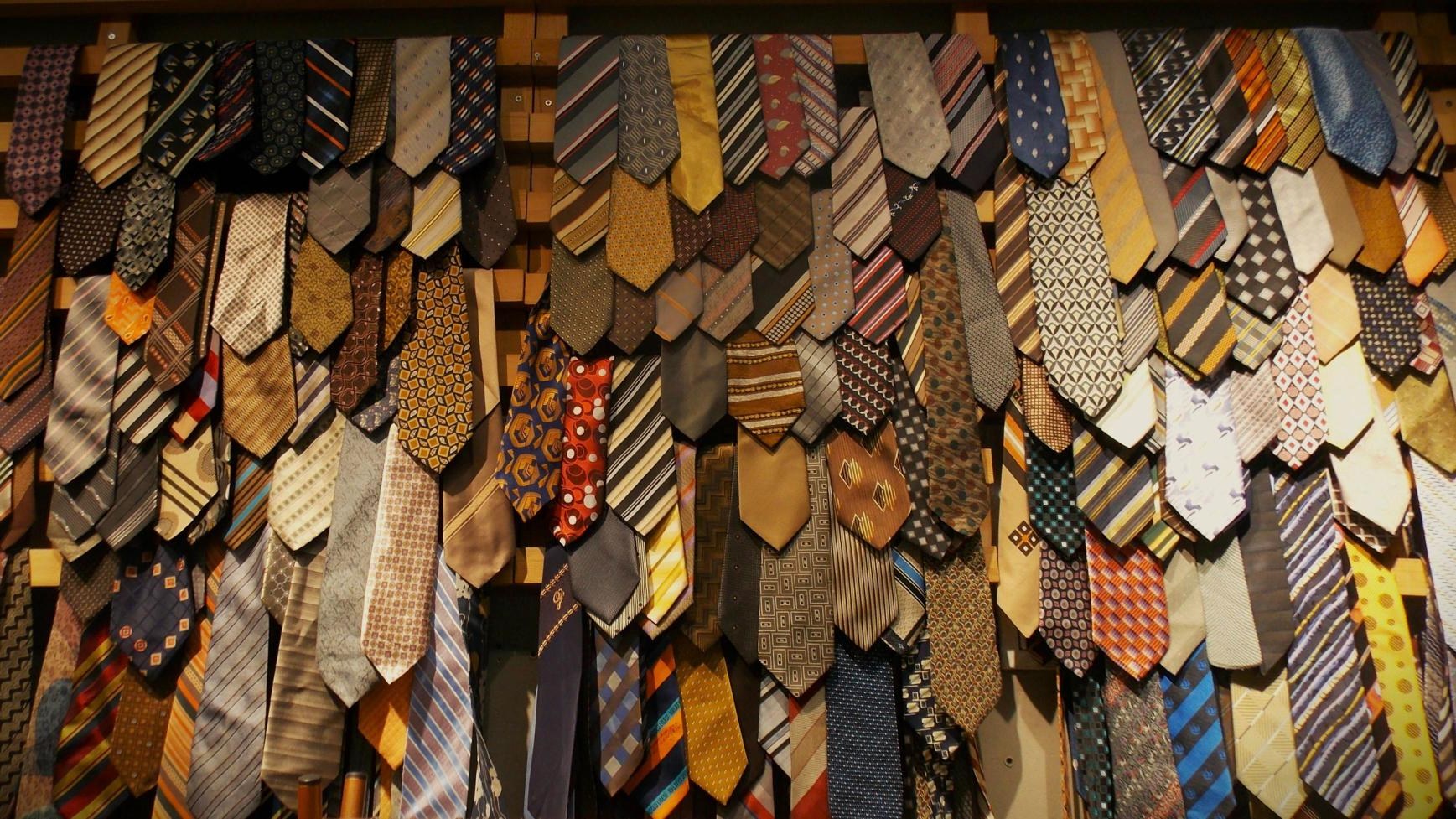
The Tie Does Nothing. That Is the Whole Point.
It began as a rag round a soldier's neck and became the most reliably gendered object in the wardrobe. Four centuries later the tie has lost the battlefield, the office, the knot - and, on TikTok, the neck. What is left is the only part that never had a use.
A tie does nothing.
It will not keep you warm. It will not hold anything up, keep anything out, or carry anything. It hangs down the front of your shirt and ends, arbitrarily, somewhere near your belt. Consider it honestly for a moment and it is a strip of cloth we have agreed to take seriously.
So why is anyone still putting one on?
Because doing nothing is the job. That is not a joke at the tie's expense — it is the reason it survived when the collar stud, the spat and the pocket watch did not. Everything else in menswear had a function it could lose. The tie had nothing to lose in the first place.
It did do something, once
The tie starts on a battlefield.
During the Thirty Years' War, Croatian soldiers fighting in French service wore lengths of cloth knotted at the throat. The French took the style and named it after the men wearing it: cravate, from Croate. Croatia has never let go of the claim — Zagreb still marks Cravat Day on 18 October, and a ceremonial Cravat Regiment in seventeenth-century uniform mounts a changing of the guard in the Upper Town.
Here is the part that matters. Even then, the cloth was already sorting people. Coarse fabric for the ordinary soldier; fine silk for the officer. Before it was fashion it was rank — a thing you could read across a parade ground at a distance.
It is often said that the original cloth was practical, a sweat rag for men in armour, and that may well be true of the coarse version. But if utility were the whole story, nobody would have bothered issuing the officers silk.
The knot that outlived its job
The knot most people tie today — the four-in-hand, narrow and slightly lopsided — carries the most romantic origin story in menswear. A four-in-hand is a carriage drawn by four horses, and the tale goes that coachmen knotted their cravats this way so the ends would not fly loose while they held the reins. Function, solved.
It is a lovely story and it may not be the true one. Reference accounts set it alongside a competing version — that drivers used the knot on the reins themselves — and treat as the likeliest explanation something far less romantic: that members of London's Four-in-Hand Club, a gentleman's driving club, simply wore their neckwear that way and made it fashionable. Not a coachman solving a problem. Men with horses, copying each other.
Which is, in miniature, the whole history of the tie. Either way, the knot's practical alibi expired a long time ago. It survives because it looks right.
A hundred years of width
What happened next is the clearest proof that function had left the building.
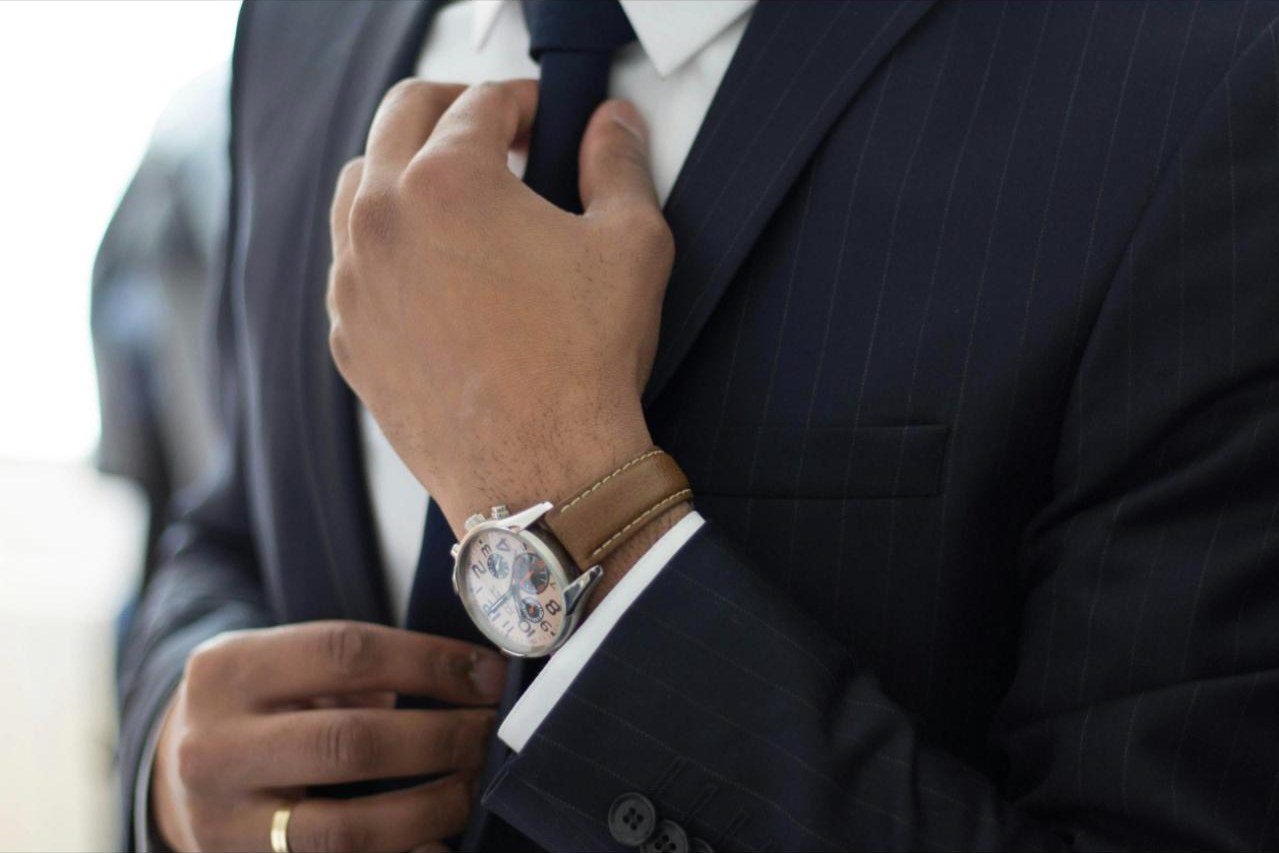
Through the twentieth century the tie did one thing over and over: it got wider, then narrower, then wider again. The broad ties of the 1930s gave way to the slim ones of the late fifties and early sixties, which gave way to the kipper of the late sixties and seventies, which gave way to the slim eighties, the loud wide nineties, and the skinny tie of the 2000s.
Not one of those cycles was driven by a problem being solved. A wide tie does not work better than a narrow one. The width was information — about the decade, and about whether you were current in it.
The tie recession, and what the numbers actually say
The received wisdom is that the tie is dying. Dress codes loosened, then the office emptied out, and the tie went with the commute.
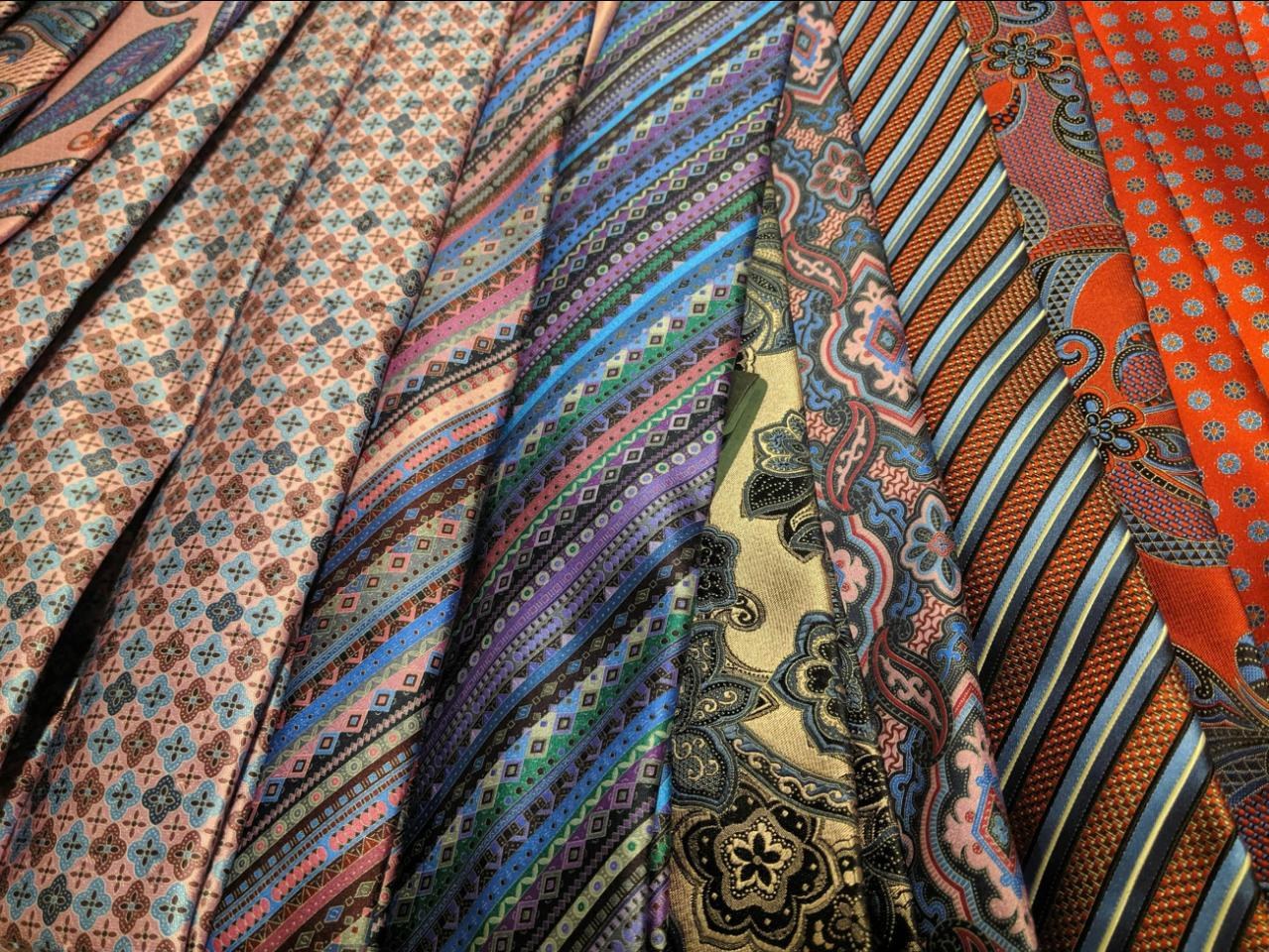
The trade figures tell a duller and more interesting story. The global tie market was worth about $2.11 billion in 2025, with forecasts of roughly $2.17 billion in 2026 and $2.75 billion by 2034 — a compound growth rate of around three per cent. That is not a corpse. It is a category that stopped being compulsory and started being chosen, which are very different conditions with similar-looking sales charts.
You can watch the same shift on any Irish racecourse. When Tariq Anwar won the Curragh's open style award in a pink Irish linen suit made in Naples, the tie he wore with it was vintage Ralph Lauren. Nobody made him. That is the point.
Then the tie escaped the collar
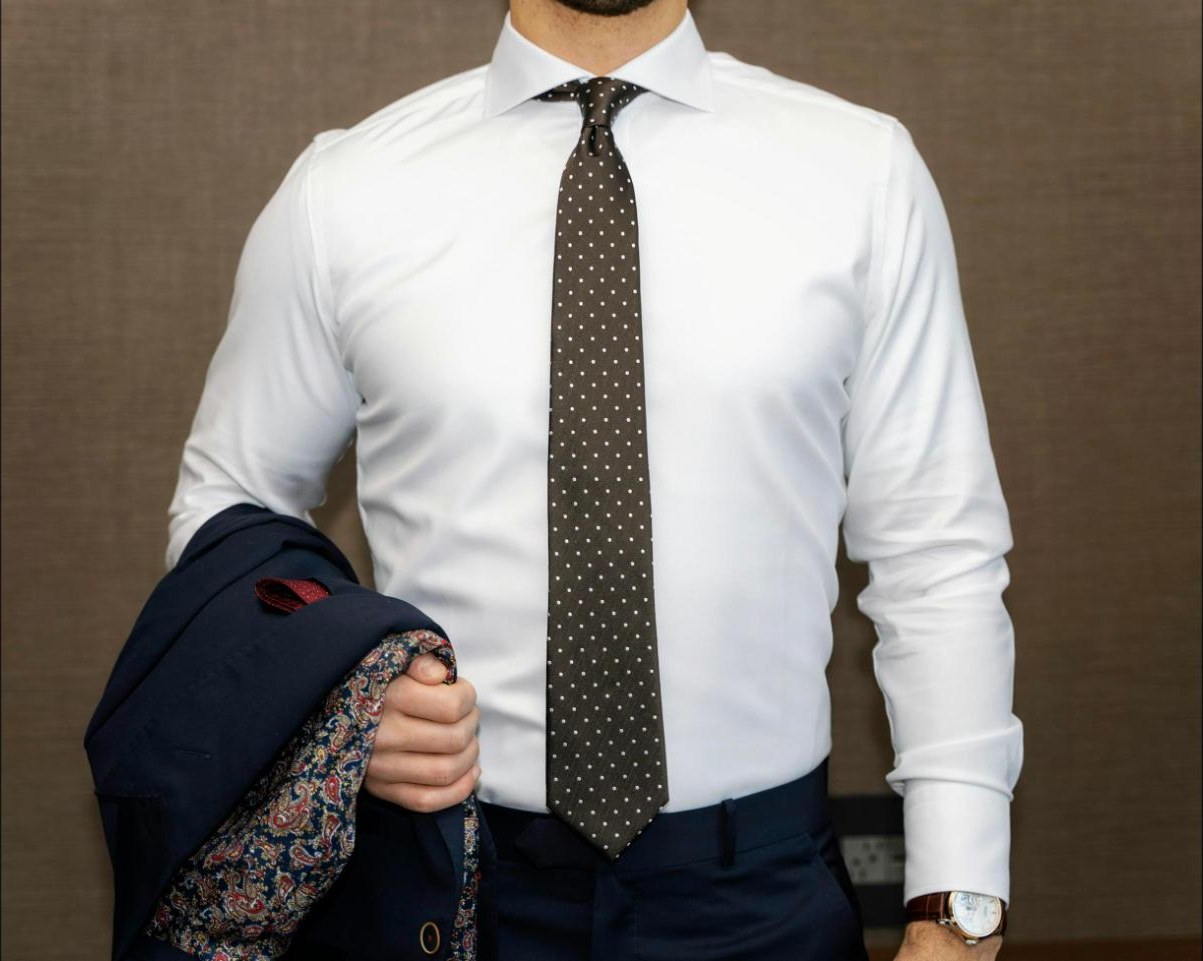
The 2026 collections did something stranger than reviving the tie. They took it apart.
- Saint Laurent showed ultra-thin glossy black ties over transparent shirts.
- Ferragamo ran leather ties, unusually long and matte.
- Thom Browne blew the proportions deliberately out of scale.
- Antonio Marras cut them drastically short, as optical punctuation.
- Alexander McQueen tied them badly on purpose — irregular knots, traditional cloth.
- Chanel went knotless, in knit.
- Aaron Esh built the tie into the shirt so it cannot be removed.
- Coach sewed classic ties flat onto denim jackets.
- Schiaparelli made one out of braided nylon jersey with brass, like plaited hair.
Look at that list again. A tie sewn into a shirt cannot be untied. A knotless knit tie has no knot. These are not neckties any more; they are pictures of neckties, applied to clothes. The garment has been reduced to pure sign, which is where it was always heading.
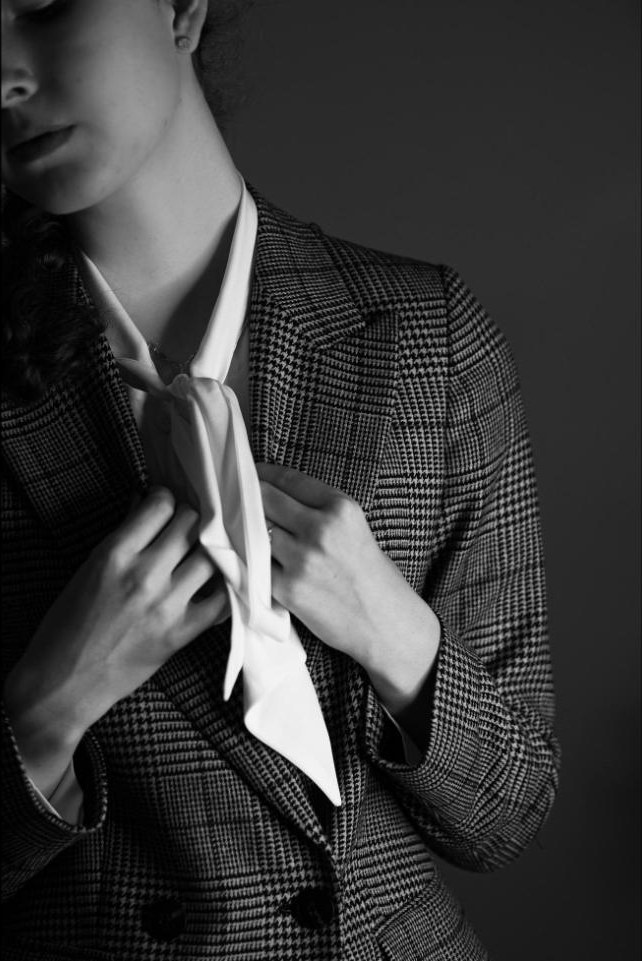
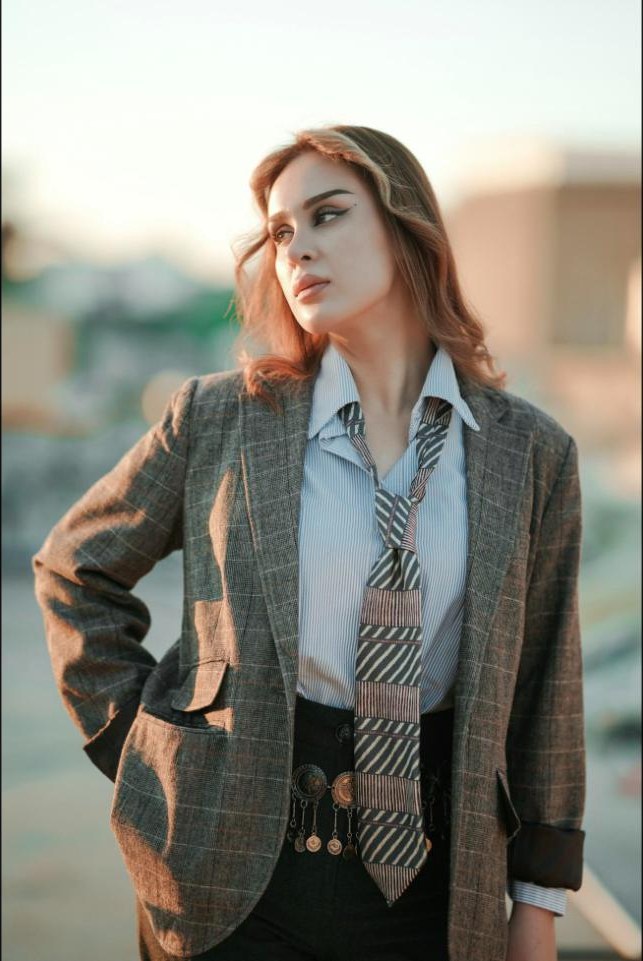
On the street outside the shows it is less theoretical. At New York Fashion Week this season the tie turned up over rugby shirts, under windbreakers, with tulle skirts, with cowboy boots and suede, over quarter-zip fleece — the stylist June Ambrose in a striped tie with a windbreaker and tulle. The reference being borrowed is the power dressing of the eighties and nineties: tie, padded shoulder, pumps.
And then it stopped being neckwear at all
The most radical thing happening to the tie is not on a runway. It is on TikTok, where a generation that never had to wear one has decided it is simply a long piece of silk with a knot in it, and started using it accordingly.
It gets tied at the waist. It gets worn as a belt. It gets folded into a bow, or tied around the head with a headband, or knotted somewhere that is nowhere near a collar.
Watch on TikTok — @dina_danh
"A tie… but make it waist detail." The single most-liked tie video we found, at over 917,000 likes. The tie is no longer neckwear; it is a waistline.
That one clip has more likes than most Irish fashion titles have readers. Elsewhere the same creator turns a tie into a bow; another demonstrates Turn a Tie Into a Belt in 10 Seconds; a corporate-styling account pairs one with a headband and files it under #womeninbusiness.
Watch on TikTok — @_tabachun_
"Ways to style a tie" — one strip of silk, several jobs, none of them the original one.
None of this is how anyone was taught. All of it works. And every single use is downstream of the same fact: once an object has no function, there is nothing to violate.
The rule the tie is really breaking
Which brings us to the thing the tie has always been best at, and the rule now coming apart.
For most of its life the tie was the most reliably gendered object in the wardrobe. Trousers went first, then jackets, then boots — but the tie held out longest, because it was never useful enough to be argued about on practical grounds. It was there to say man at work, and it said it clearly.
So women took it, and every time they did it made news.
Marlene Dietrich in white tie and tails. Patti Smith on the cover of Horses in 1975, white shirt, black ribbon at the throat, jacket hooked over one shoulder. Yves Saint Laurent's Le Smoking, which put a woman in a tuxedo in 1966 and got her turned away from restaurants for it.
And Diane Keaton in Annie Hall, 1977 — men's white shirt, black waistcoat, baggy khakis, and a wide polka-dot tie. That look is routinely credited to Ralph Lauren, and Lauren himself has been straighter about it than the myth: "Annie's style was Diane's style… We shared a sensibility, but she had a style that was all her own. Annie Hall was pure Diane Keaton." Keaton's own account gives the credit further away again — to "all the street-chic women livening up SoHo in the mid-seventies. They were the real costume designers." The director's instruction to the film's costume designer was, reportedly, to leave her alone and let her wear what she wanted.
What is different in 2026 is the reading. When Dietrich or Keaton wore a tie, the charge came from the borrowing — a woman in men's clothes, and everyone knew whose clothes they were. Watch the same garment on TikTok now and the borrowing has quietly stopped. One of the most-liked tie videos on the platform is captioned, in full, "It's beyond gender." Three words, 141,000 likes, no argument attached.
Watch on TikTok — @eleonorlauren
"It's beyond gender." The caption is the entire argument, and 141,000 people agreed without needing it explained.
The other end of the same shift is more deliberate. There is a whole seam of styling filed under #masc, #butch and #ties — women and non-binary people wearing the tie precisely because of what it has always signalled, and keeping the signal rather than neutralising it. Both things are happening at once: the tie is losing its gender for some people and being claimed for its gender by others. It can do that, because it means whatever the wearer is willing to carry.
Watch on TikTok — @siggy.png
Filed under #masc, #butch and #ties — the tie kept for exactly what it signals, rather than defused.

The tailoring argument, and where Melania Trump fits
The most-watched version of this argument is not on TikTok at all. It is on the woman who dresses knowing every frame will be read.
Melania Trump has spent recent years moving steadily into menswear tailoring. She wore a menswear-inspired Dolce & Gabbana tuxedo for her official White House portrait, and another to the Governors' Dinner. As one style report put it in March 2026, "in recent appearances, particularly during her husband's second term, Trump has leaned further into menswear-inspired dressing."
One precision is worth making, because it is the whole distinction this article rests on: she wears the silhouette, not the tie. Tuxedo jackets, sharp shoulders, trousers, a shirt — but we could find no example of the necktie itself. She takes the authority of the shape and stops short of the one item that is nothing but signal.
Whether you read that as discipline, restraint or calculation depends largely on what you already think of her, and her clothes are argued over from every direction — praised as controlled and modern in some quarters, criticised as inappropriate or evasive in others. We are not going to settle that here, and the disagreement is itself the evidence. She is among the most-discussed dressers alive precisely because she appears to understand what the rest of this article is about: that clothes are read whether or not you intend them to be, and that the least functional item is usually the loudest.
You cannot opt out of the signal. You can only decide what it says.
What is left
So the tie has been stripped, one layer at a time. It lost the battlefield. It lost the sweat. It lost the reins, if it ever had them. It lost the office, or most of it. This season it is losing the knot, and on TikTok it has lost the neck.
What is left is the only part that was never functional to begin with — the part that tells people something about you. That you had ten minutes this morning to do something unnecessary. That you were not expecting to do physical work today. That you know the rules well enough to follow them, or well enough to break them on purpose.
It does nothing. That same nothing still says something. And if it did not, we would have thrown it out centuries ago.
A note on the sourcing
The Croatian origin of the cravat and Croatia's Cravat Day on 18 October are drawn from reference accounts of the Thirty Years' War Croat units and of Zagreb's ceremonial Cravat Regiment. The four-in-hand knot's origins are genuinely disputed: the coachman story is widely repeated, but standard reference accounts treat London's Four-in-Hand Club as the likelier source, and we have presented it that way rather than pick the better story.
Tie market figures — $2.11bn in 2025, a projected $2.17bn in 2026 and $2.75bn by 2034 — are as published in trade coverage of the category. The 2026 collection details and the New York street-style observations are from fashion press reporting of those shows. The TikTok figures were observed on 23 August 2026 and will have moved since.
The Annie Hall quotations from Ralph Lauren and Diane Keaton are as published in reporting on the film's costuming. The Melania Trump quotation is from a style report dated 25 March 2026; the tuxedo appearances are as reported by the fashion trade press. We looked for a documented instance of her wearing a necktie and did not find one, which is why the article says so rather than implying otherwise.
Photographs are used under the Unsplash Licence. In order of appearance: Yiğit Efe Kuyu (the tie wall, lead image), Ruthson Zimmerman, Solstice Hannan, Benjamin R., Laura Chouette, Aydin sefidi and lhon karwan.
You Might Also Like
The latest from The Moiré Edit.