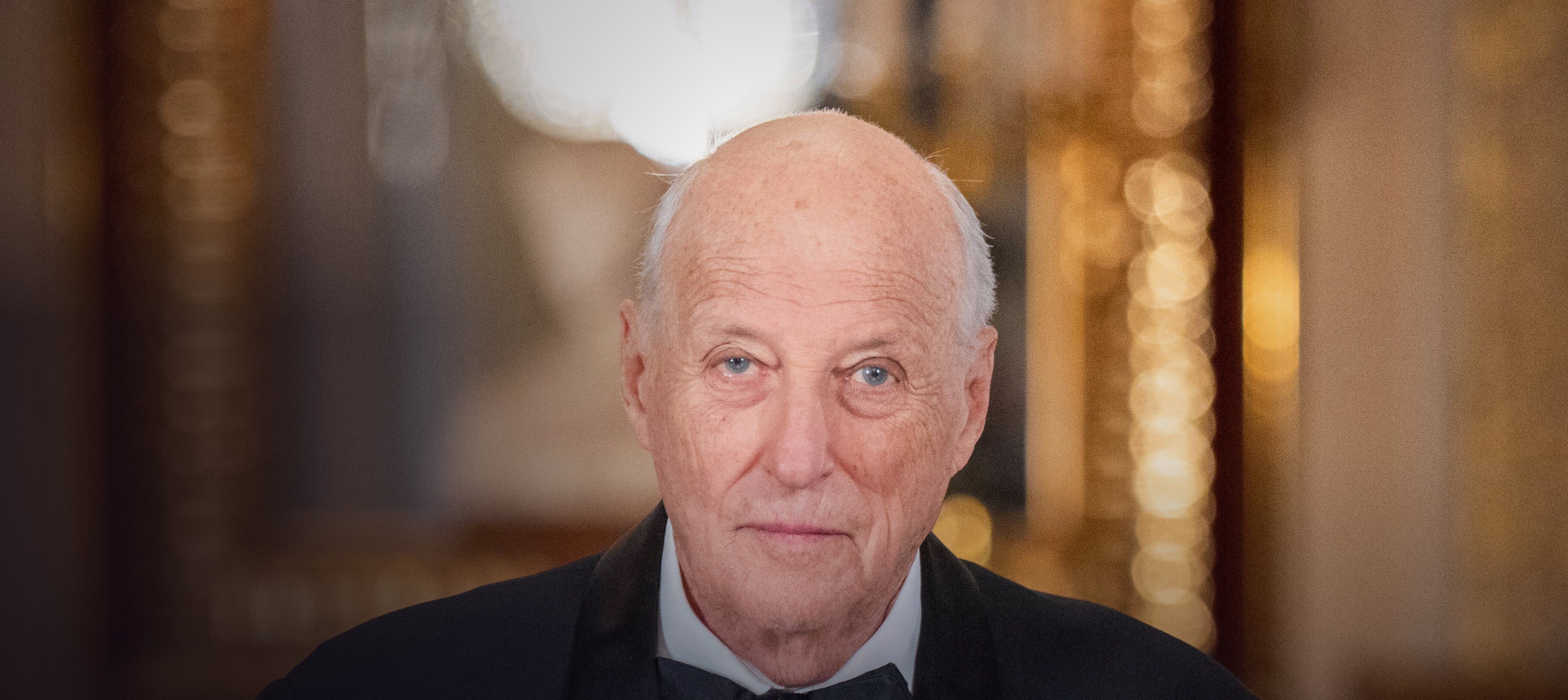
King Harald V, 1937–2026: The King Who Would Not Marry Anyone Else
He died at 6.35 on Friday morning, one day short of his fifty-eighth wedding anniversary. Europe's oldest monarch waited nine years for a businessman's daughter, and let his father understand he would rather end the dynasty than give her up.
King Harald V delivering the New Year’s speech at the Royal Palace in Oslo, photographed on 20 December 2024. Photo: Heiko Junge / NTB / Alamy Stock Photo.
King Harald V of Norway died at 6.35 on Friday morning at Rikshospitalet in Oslo. He was 89.
He died one day short of his fifty-eighth wedding anniversary — to the woman he waited nine years for, and whom, as sole heir to the throne, he let his father understand he would rather lose the dynasty than lose.
“It is with deep sorrow that we announce that His Majesty King Harald passed away today. King Harald passed away peacefully at Rikshospitalet on Friday 28 August at 06.35.”
The Royal House of Norway
He had been admitted on 17 August with haemolytic anaemia, a condition in which red blood cells are destroyed faster than the body can replace them. On 23 August he deteriorated with a bacterial blood infection. On Thursday the palace said his condition was “extremely serious”. Crown Prince Haakon kept vigil overnight.
His son became King Haakon VIII the moment he died.
KING HARALD V
1937–2026
BORN
1937
21 February, at Skaugum, Asker. The first prince born in Norway in 567 years.
KING FROM
1991
17 January, on the death of his father Olav V.
REIGNED
35 years
Thirty-five years, seven months and eleven days.
DIED
2026
28 August, 06.35, at Rikshospitalet, Oslo. Aged 89.
Sources: The Royal House of Norway; the Office of the Prime Minister of Norway.
The nine years
He met Sonja Haraldsen in June 1959, at a party given by a mutual friend. He was 22 and the heir to the throne. She was a businessman’s daughter with a diploma in dressmaking who had studied in Switzerland.
They courted, largely in private, for nine years. Norway spent most of that time being told, by people who considered themselves authorities on the matter, that a crown prince marries a princess.
After his thirtieth birthday in 1967, Harald let his father know that if he could not marry Sonja he would not marry at all. He was Olav V’s only son. There was no other heir. The line would simply have stopped.
Olav consulted his government. The advice came back that ministers could not formally approve the marriage, but would not publicly oppose it if the King consented. On 18 March 1968 Olav announced the engagement in a statement to the President of the Storting, and flags went up on public buildings across the country.
They married at Oslo Cathedral on 29 August 1968. The reaction was jubilant. Fifty-seven years later, they were still married when he died.
The boy who left in April and came home in June
Germany invaded Norway on 9 April 1940. Harald was three. His mother, Crown Princess Märtha, took him and his two sisters across the border into Sweden. His father and grandfather went to Britain with the government-in-exile.
In August 1940 Märtha and the children were evacuated to the United States, at President Roosevelt’s invitation, and spent the war living near Washington. They came home on 7 June 1945.
He took his upper secondary certificate at Oslo Cathedral School in 1955, finished at the Norwegian Military Academy in 1959, and studied social science, history and economics at Balliol College, Oxford, from 1960 to 1962. He became Crown Prince at twenty, on the death of his grandfather Haakon VII in September 1957.
The sailor
He raced. Not ceremonially — competitively, for sixty years, in more than a thousand regattas.
THE OLYMPICS
Three Games, no medal
TOKYO 1964
8th
5.5 Metre class, in Fram III. He carried Norway’s flag at both the opening and closing ceremonies.
MEXICO 1968
11th
5.5 Metre class, in Norway.
MUNICH 1972
10th
Soling class, in Norway.
WORLD TITLE
1987
World champion in Fram X — the One Ton Cup, off Kiel.
Source: Olympedia; the Royal House of Norway.
He never won an Olympic medal, and it is worth saying so plainly on a day when a good deal of coverage will imply otherwise. What he won was a world championship in 1987 and a European championship in 2005, in Fram XV. He was still racing in his mid-eighties.
His father had been an Olympic champion sailor, in 1928. As King, Harald opened the Lillehammer Winter Olympics in 1994.
“It lasts for life”
The last two years of his reign were a long argument about whether it should end. He was hospitalised repeatedly: bladder cancer surgery in 2003, heart valve surgery in 2005 and again in 2020, infections in 2022 and 2023. In February 2024 he fell ill on a private holiday in Langkawi, Malaysia, and had a temporary pacemaker fitted there before being flown home; a permanent one followed in March.
When Denmark’s Queen Margrethe II abdicated in January 2024, he was asked whether he might do the same.
“No, I don’t really have it. I stand by what I have said all along. I have taken an oath to the Storting, and it lasts for life.”
King Harald V, on abdication, 2024
He cut his engagements sharply and let Crown Prince Haakon act as regent when he could not. He did not step down.
The speech
On 1 September 2016, at a garden party in the Palace Park in Oslo, in the year of his and Sonja’s twenty-fifth anniversary on the throne, he gave a short welcoming address that went around the world. NRK’s clip passed two million views.
He began by observing that his own grandparents had emigrated from Denmark and England some 110 years earlier.
“Norwegians are girls who love girls. Boys who love boys. And boys and girls who love each other. Norwegians believe in God, Allah, everything and nothing.”
King Harald V, Palace Park, Oslo, 1 September 2016
And, in the same speech: “It’s not always easy to say where we come from… Home is where the heart is. That cannot always be placed within country borders.” And: “Norway is you. Norway is us.”
It was a constitutional monarch, in a country with an established Lutheran church whose faith he was legally required to profess, standing in his own garden and telling his subjects that a Norwegian could believe in Allah or in nothing at all. He was 79.
What happens now
Accession in Norway is automatic and instantaneous. Crown Prince Haakon, 52, became King Haakon VIII at 6.35 on Friday morning.
Under Article 9 of the Constitution he must swear an oath before the Storting — and there is a wrinkle. The Storting is normally in recess in late August. If it is not sitting, the Constitution provides for the oath to be made in writing in the Council of State and repeated before the Storting when it next convenes. When Harald acceded on 17 January 1991, he swore his oath four days later. No date has been announced.
There will be no coronation. The Storting removed that requirement in 1908; the last Norwegian coronation was in 1906. Olav V substituted a benediction at Nidaros Cathedral in Trondheim in 1958, and Harald and Sonja followed in June 1991.
THE SUCCESSION
Where the crown goes
The King
Haakon VIII, born 20 July 1973. Crown Prince Mette-Marit becomes Queen.
The heir
Princess Ingrid Alexandra, born 21 January 2004, becomes Crown Princess.
Then
Prince Sverre Magnus, then Princess Märtha Louise and her three daughters.
The law
Norway adopted absolute primogeniture on 29 May 1990 — but not retroactively. Article 6 still provides that for those born before 1990, a male takes precedence. That is why Haakon, born 1973, outranked his elder sister Märtha Louise, born 1971.
When Ingrid Alexandra succeeds, she will be Norway’s first female monarch since Margaret, who ruled Norway, Denmark and Sweden from the late 1380s until her death in 1412 — and the first ever to inherit by right of birth order alone.
Ireland, 2006
He came here. In September 2006 Harald and Sonja made a state visit to Ireland, hosted by President Mary McAleese. The royal yacht Norge lay at Dún Laoghaire. There was a wreath at the Garden of Remembrance and a state dinner at Dublin Castle, then an overnight passage by sea to Cork Harbour, a plaque at the Naval Service base on Haulbowline, and a maritime governance conference the King opened at the National Maritime College in Ringaskiddy.
McAleese’s speech at the state dinner is still on the record, and it is worth reading today. She told him that by sailing into Dublin Bay that morning he had “dramatically stirred our imaginations” — an echo, she said, of the arrival of his Viking predecessors up the Liffey.
Then she reached for a twelfth-century King of Norway called Harald Gille, who was Irish-Norse, and whose full name she suggested may have been Giolla Íosa — servant of Jesus.
“I confess that I have a personal interest in him, as it seems he shares my name in Irish, Mac Ghiolla Íosa.”
President Mary McAleese, state dinner at Dublin Castle, September 2006
She returned the visit in October 2008, when Harald hosted her in Norway.
What is being said
Norway’s Prime Minister, Jonas Gahr Støre, said a whole nation was in mourning and that the people of Norway were left with a deep sense of gratitude “for a long life in the service of Norway”. The government’s statement is headed, simply, En hel nasjon er i sorg — a whole nation is in mourning.
King Carl XVI Gustaf of Sweden, who now becomes Europe’s oldest reigning monarch, said: “Throughout the years, King Harald has been a good friend to me, my family, and to Sweden.”
The flag over the Royal Palace in Oslo was lowered to half-mast. People began arriving with flowers.
As of writing there is no statement from President Catherine Connolly or from the Taoiseach.
The last two years
An honest obituary has to note that the reign ended under a shadow that had nothing to do with him. In June this year Marius Borg Høiby, Crown Princess Mette-Marit’s eldest son from a previous relationship — not a member of the Royal House, untitled, and not in the line of succession — was convicted of rape and sentenced to four years’ imprisonment. Earlier in 2026 Mette-Marit faced renewed scrutiny over past contacts with Jeffrey Epstein. She was not accused of any wrongdoing and apologised for disappointing people.
Harald was in hospital for much of it. He is survived by Queen Sonja, by King Haakon VIII and Princess Märtha Louise, and by five grandchildren.
What he actually was
He was Europe’s oldest monarch, and the oldest in more than eleven hundred years of Norwegian kingship. He was not Europe’s longest-reigning — that is Carl XVI Gustaf of Sweden, and before him Hans-Adam II of Liechtenstein — and a good deal of today’s coverage will blur the two.
What he was, precisely, was a man who inherited an office with almost no power and used the only thing it does confer, which is the ability to say something in front of everybody. He used it to say that a Norwegian could be an immigrant, or gay, or a believer in nothing. And long before that, at thirty, he used the only real leverage a sole heir has, once, to marry the person he wanted.
His motto was his father’s and his grandfather’s: Alt for Norge. All for Norway.
HOW THIS PIECE WAS SOURCED
The death, its time, place and medical background are from the Royal House of Norway and the Office of the Prime Minister, with reporting from Reuters, AP, NPR, CNN and Euronews. Biographical detail is from the Royal House’s official biography; the Olympic placings from Olympedia; the constitutional mechanics from the Storting’s official English text of the Constitution. The 2016 speech is dated to 1 September 2016 by the Royal House’s own page for it, and the English wording is corroborated across The Local, the World Economic Forum and MambaOnline. The Irish state visit and President McAleese’s remarks are from The Irish Times of 18 September 2006 and from president.ie.
Several things in wide circulation today are wrong, and we have not repeated them. He was not Europe’s longest-reigning monarch. He acceded on 17 January 1991, not the 21st — that is the date of his oath. Norway was occupied in 1940, not 1939. He studied at Balliol but is not recorded as taking a degree. And the line “if I cannot marry Sonja, I shall not marry at all” circulates as a direct quotation but cannot be traced to a primary source, so we have reported its substance rather than quoting it.
No funeral date, mourning period, lying-in-state schedule or oath date had been announced when this was published. We will update.
You Might Also Like
The latest from The Moiré Edit.