Two Days at the Curragh
The Dubai Duty Free Irish Derby weekend ran two style competitions. A pink Irish linen suit made in Naples, worn with shoes from Marks & Spencer, won Saturday's open award - and its winner was the only man among ten finalists.
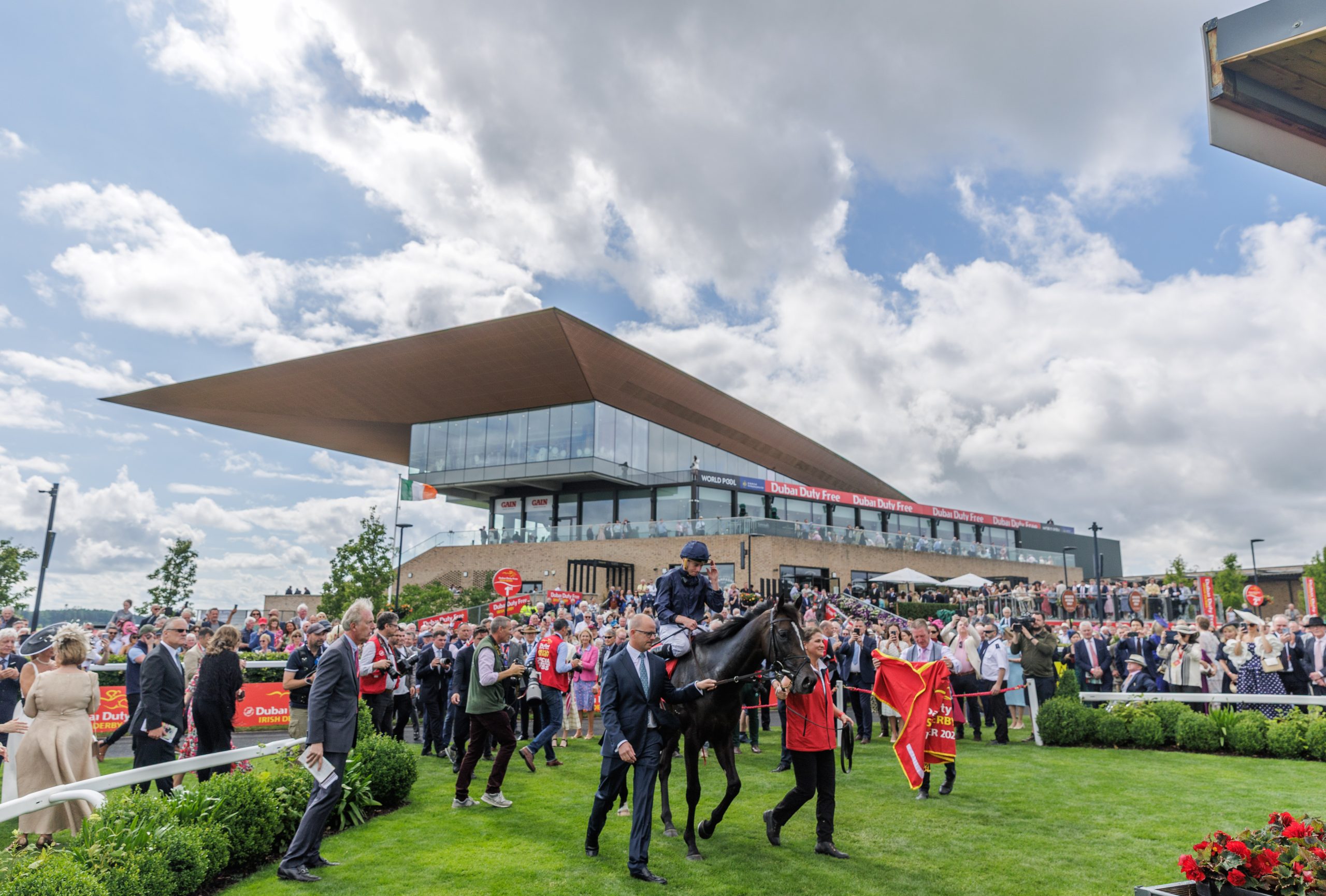
The Dubai Duty Free Irish Derby is a two-day fixture, and the Curragh runs a style competition on each of them. Saturday 27 June belonged to The K Club's Most Stylish Racegoer. Sunday 28 June, Derby day proper, belonged to the Dubai Duty Free Best Dressed Competition, the one with the title sponsor's name on it and the flights to Dubai attached.
Two days, two panels, two winners. Read side by side, they say more about how Irish racing handles style than either would on its own.
Saturday: a pink suit and a shopping list
The suit was pink. It was cut from 100% Irish linen, and it was made in Naples. The trousers were flared, the braces red, and there was a 1950s collar pin doing quiet work at the throat.
The hat came from Kennedy and McSharry on Nassau Street. The shirt was Reiss. The tie was vintage Ralph Lauren. The sunglasses were H&M. The shoes were Marks & Spencer.
It is worth pausing on that shopping list before anything else, because it demolishes an assumption people carry into these competitions. The winning look at the Irish Derby paired a bespoke Neapolitan jacket in Irish cloth with high-street shoes and high-street sunglasses.
The man wearing it was Tariq Anwar, originally from India, resident in Ballsbridge for eleven years. Working to a theme of "1950s pastels", he was — as RTÉ put it — the only man to make it into a line-up of ten finalists.
The judges were Aurelija Kupryte of The K Club, the singer Úna Healy, and the Curragh's style MC Marietta Doran. Healy's reported reason for choosing him was the blend of race-day sophistication with the 1950s theme. His prize: a three-night break for two at The K Club. The runners-up, Veronia Walsh from Meath and Aoife Newe from Cork, each took an overnight stay with dinner.
Watch on TikTok — @racestyleandsocial
Race Style & Social's own footage of Saturday's K Club Most Stylish Racegoer competition at the Curragh, dated 27/06/2026: a yellow broderie halter dress with a white disc hat, a teal coat-dress with a navy disc, a pink floral with a rose headpiece.
The "first ever" claim, handled carefully
RTÉ reported his win in its opening sentence as making him "the first ever male winner of the prestigious title".
That is the claim, and it is worth being precise about its status. The Curragh published no results announcement of its own. No other outlet appears to have covered the Saturday result. So the "first ever" rests entirely on RTÉ's reporting — a reputable source, but a single one, and we could not independently corroborate it against the competition's own history.
What we can say with confidence is that the award is genuinely open. One title, one winner, no parallel gentleman's category, gender-neutral wording throughout. That is the thing that makes his win meaningful. Men win men's categories at Irish racecourses every summer and it is not news. A man winning an award everybody was competing for is a different event.
Sunday: the flagship
Then Derby day, and the competition that carries the weekend's real weight.
The Dubai Duty Free Best Dressed Competition is judged by Vogue Williams alongside Alpana Cidambi and the fashion writer Bairbre Power. It was won by Jeanette Kelly from Enniscorthy, Co. Wexford, in a caped ensemble with matching headpiece and bag — the dress from her own wardrobe, a blush Laura Hanlon headpiece rented from Hats Amore, accessories from Next, and a cape by the Ukrainian designer Malva Flores.
A rented headpiece and a dress already hanging in the wardrobe. Again: the money was not the differentiator.
The final line-up contained "two suits and a range of beautiful gowns", so men were competing on Sunday too, and did not win. One of the runners-up was Kimberly Tino of Meath, founder of Maya Grisham, carrying a harp clutch of her own making. Ann Marie Dunning also placed.
Watch on TikTok — @racestyleandsocial
"More style from the Dubai Duty Free Irish Derby @The Curragh Racecourse" — Race Style & Social's second sweep of the weekend.
Now compare the two days
Saturday, open to all, won by a man: three nights at a hotel in Kildare.
Sunday, the flagship, won by a woman: return flights for two to Dubai, five nights at the Creekside Hotel, and €1,000 in spending money.
So the historic result happened in the smaller competition, and the big one went the way it always goes. That is not a criticism of either winner — both were chosen by independent panels and both, on the evidence, deserved it. It is just the shape of the weekend, and any honest account of it has to include that shape.
The prize gap, in numbers
Once you start looking at what men and women are actually competing for at the same meetings, the pattern is hard to unsee.
The sharpest example is the Curragh's own recent history. When the Derby festival ran a split award in 2023, the Most Stylish Lady received flights to Dubai, five nights' accommodation and €1,000. The Most Stylish Man received a €500 Kildare Village voucher and a golf simulator.
Elsewhere in Ireland:
- Galway 2026 — a €10,000 Best Dressed Lady prize, plus a separate award for the best hat. There is no men's category at all.
- Listowel 2022 — a €1,000 suit for the men's winner, against a New York trip plus €1,000 for the ladies'.
- Punchestown — a men's award backed by Louis Copeland, run alongside a far larger ladies' prize.
The international comparisons run the same way. Dubai World Cup 2026 offered US$15,000 to its Best Dressed Lady and US$10,000 to its Best Dressed Man — a gap, but the closest to parity of any major meeting. Aintree's 2026 Best Dressed winner took a trip valued up to £4,000; Best Suited took a £1,000 voucher.
Australia's history is the most instructive, because it shows the gap being closed deliberately. At Flemington in 2014, the national Fashions on the Field women's winner drove away in a Lexus valued at A$77,465, from a prize pool of A$140,000. The men's winner received a twelve-month lease on a Lexus valued at A$20,000, from a pool of about A$58,000.
By 2023 the two categories were at parity — both worth over A$54,000, each including A$45,000 in cash. In 2024, A$20,000 cash each.
It can be fixed. Somebody just has to decide to fix it.
Horse Racing Ireland's own coverage of Best Dressed at Galway — a different meeting, but the format exactly as the sport itself presents it.
Do men deserve more of a stage?
This is where the Derby weekend earns its argument, and it is worth putting both sides properly.
Australia's Fashions on the Field began at Flemington in 1962. It added a men's category, Men's Racewear, in 2001. Then in 2022 it abolished that category, replacing it with a gender-neutral "Best Suited" running alongside "Best Dressed". Aintree copied the structure in 2026. The reasoning was articulated by the designer Deb Saywell: "fashion is not gender specific." Hard to argue with as a principle.
Except that in 2025, Flemington's Best Suited was won by a woman — Jenny Beard, in a handmade three-piece. In the same year, a man placed second in Best Dressed.
Which is the finding that should give everyone pause, including anyone arguing that gender-neutral categories are the answer for men. Removing the men's category did not reliably give men a stage. It gave everyone the same two stages, and women kept winning both.
If your objective is fairness, that outcome is correct and unremarkable. If your objective was more visibility for men, the mechanism does not deliver it.
Watch on TikTok — @racestyleandsocial
Niamh Lorden and Michael Fitzpatrick run down the style at the Curragh for the Dubai Duty Free Irish Derby, 28/06/2026 — including a man in a patterned white suit and black hat, one of the few in shot.
The Aintree judge Rachael Rhodes — a woman, judging a competition built around women — is on record wanting more of it: "I love it when the men look really dapper and there are always suits that really catch your eye." She is equally clear that women in suits are just as welcome, which is the right instinct.
And the serial Australian men's winner Neil Carpenter gave the best description I have found of what it feels like to compete as a man in this arena. He said it was like being "the boy who somehow wandered into the VIP room."
That is the actual problem. Not prize money — atmosphere. A man entering a race-day style competition in Ireland is doing something faintly unusual, and the structures make sure he knows it. Which is why Tariq Anwar being the only man among ten finalists is the more revealing statistic of the whole weekend. He did not just win. He was, on the day, the only one of him.
And the argument against
Now the other side, because it is stronger than men's-style advocates tend to allow.
These competitions exist for a commercial reason, and racing has stopped pretending otherwise. Cheltenham reverted to a branded Ladies Day from 2026, and stated the purpose plainly: the primary focus was on growing the number of female racegoers in attendance.
That is a racecourse saying out loud that the gendered fashion day is a customer-acquisition tool. Ladies' Day exists because it sells tickets to women, and the prize fund is a marketing budget aimed at the people it is trying to attract. Viewed that way, the disparity is not an injustice. It is a media buy.
There is also a critique of the whole apparatus that deserves airing: that dressing people up, parading them past a panel and ranking them by appearance is not obviously something to expand. Some of those arguing for men's inclusion are arguing to widen a format others would rather see narrowed.
And Royal Ascot, which has the strictest dress code in world racing — morning dress, waistcoat, tie, a top hat that must be worn in the Royal Enclosure, no cravats — runs no best-dressed competition at all, for anybody. It publishes a style guide and expects compliance. That is a coherent alternative position: regulate the dress, don't rank the wearer.
So will other racecourses follow the Curragh?
Some already have, in the sense that matters least: several Irish meetings run a men's award. Killarney crowns a Best Dressed Gent — Tariq Anwar won that one too, in July, taking a trip to Milan. Punchestown has its Louis Copeland award. Listowel has run one.
What almost none of them do is fund it at anything approaching the women's level, or put it on the same stage on the same day with the same judges and the same photographer.
The realistic prediction is that more will follow the label — a men's award, a menswear sponsor, a photograph — because it costs little and reads well. Fewer will follow the money, because the money is aimed at the audience they are trying to grow.
What would actually work
If a racecourse genuinely wants men competing rather than decorating, the Australian evidence points at three things, and none of them is a separate category.
Equalise the prize. Flemington did it. It is the only signal that cannot be misread.
Same day, same stage, same judges. A men's award announced in a side tent at four o'clock is not a competition, it is a courtesy. The Curragh, to its credit, had it right on Saturday — one open award, one panel, one winner.
Judge on the same terms. Menswear is more codified, which is precisely why a genuinely good men's look is a harder problem and a more interesting one to reward. Ten finalists containing one man is not a men's participation problem. It is a signal problem, and racecourses control the signal.
Tariq Anwar solved it for himself by simply entering, in a pink Irish linen suit made in Naples, with shoes from Marks & Spencer. On the evidence of the Derby weekend, the clothes were never the obstacle.
A note on the sourcing
The outfit details, judges, prizes and runners-up for both Curragh competitions come from RTÉ's reports of 27 and 28 June 2026. Neither article contains any direct quotation — every judge's comment is reported indirectly — so nothing here appears inside quotation marks that was not spoken inside them.
The "first ever male winner" claim is RTÉ's, quoted as theirs. The Curragh issued no results announcement and no other outlet covered the Saturday competition, so it stands on a single source.
Prize values elsewhere are as published by the racecourses concerned and are not always directly comparable — a cash prize, a hotel package and a car lease are different kinds of thing. Where a value was never published, we have described the prize rather than estimating it.
Videos are shown via TikTok's and YouTube's official embeds and remain the property of their creators. The Curragh footage is by @racestyleandsocial.
You Might Also Like
The latest from The Moiré Edit.