Donegal: Ireland's Wild, Defiant North-West
Sea cliffs three times the height of Moher, gold beaches you will have entirely to yourself, and a county that has never once tried to charm you — which is exactly why it does.
Donegal does not audition for you. There is no scenic-route branding at the county line, no cluster of coach parks at the good bits, no sense that anyone has arranged the landscape for your benefit. It simply goes on being enormous and half-empty and frequently drenched, and if you happen to be there for it, that is your good fortune rather than its business model.
This is the least visited stretch of the Wild Atlantic Way and the most rewarding. What follows is what to actually do with a week of it — the cliffs, the beaches, the headlands, the tweed, and the practicalities of a county that is a great deal bigger and slower than the map suggests.
The cliffs, and an honest correction
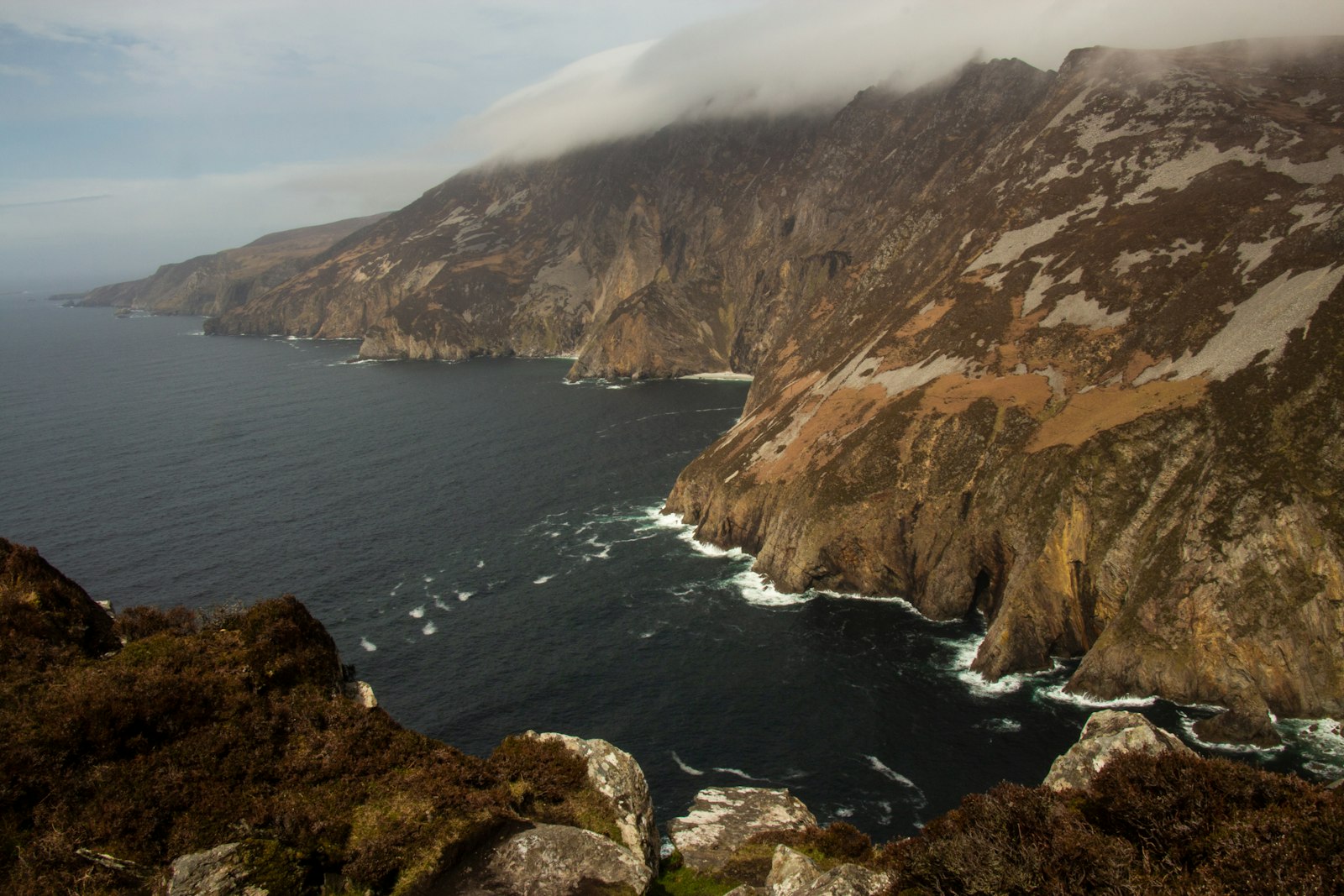
You will read that Sliabh Liag has the highest sea cliffs in Europe. It doesn't, and the visitor centre is admirably careful to say only that they are among the highest. At 601 metres they are not even the highest in Ireland — Croaghaun on Achill Island is both higher and marginally steeper. What they are is nearly three times the height of the Cliffs of Moher with a small fraction of the crowd, which is a far better boast and happens to be true.
The practicalities matter here more than at most Irish sites. Park free at the Visitor Centre, four kilometres out, and take the shuttle — €6 an adult, €4 a child, €20 for a family, first bus at 10:10 and roughly every forty minutes after, every twenty at peak. It runs July, August and September plus most bank-holiday weekends. Outside those months you can buy a ticket at the Ranger Station and drive up yourself: €5 for two hours, €10 for four, €15 for the day. In high season, vehicle access to the upper car park is restricted, so the shuttle is not the compromise — it is the plan.
The site itself is open 09:30 to 17:00 year-round, though the cliffs never close. A 2.5-kilometre upland path was built in 2017–18 as part of a €4.95m development project, largely to stop 160,000 annual visitors wearing the mountain away. The main viewing platform at the top car park is wheelchair accessible. Beyond it runs One Man's Pass, the knife-edge traverse to the summit that Robert Lloyd Praeger called one of the most remarkable walks in Ireland — and which you should not attempt in wind, in cloud, or in the shoes you drove in.
Glenveagh, and the mountains behind it
Fifteen thousand hectares of the Derryveagh Mountains, and the park itself costs nothing. You pay only for the castle: €10 self-guided, €15 for a pre-booked guided tour, €7 and €12 respectively for seniors, students and youths, under-sixes free. The shuttle from the visitor centre is €5 return. Note the castle closes on Mondays and Fridays and the last tour goes at 16:45 — a detail that has ruined more than one carefully planned afternoon.
The exhibitions are better than they need to be. One covers the golden eagle reintroduction — the birds are back, along with peregrines, red-throated divers and red deer. The other covers the Derryveagh Evictions of 1861, when 244 people were put out of their homes on this estate. It is unusual and to the park's credit that a place this beautiful is willing to tell you what was done to the people who lived here, rather than letting the scenery do all the talking.
Donegal does not perform for you. It simply goes on being enormous and half-empty, and if you are there for it, that is your good fortune.
Beaches you will have to yourself
Silver Strand at Malin Beg, near Glencolmcille, is a perfect horseshoe of sand reached by a steep flight of steps from the car park — around 170 of them, depending on whose count you believe. It is roughly ninety minutes from Donegal Town and worth every one of them.
Ballymastocker Bay at Portsalon, out on the Fanad peninsula, is a Blue Flag beach and a long, pale, improbable curve of sand. You will see it described as the second most beautiful beach in the world; that comes from an old newspaper readers' poll that nobody can now produce, so enjoy the beach and ignore the accolade.
Murder Hole Beach on the Rosguill peninsula — Boyeeghter Bay, or Trá Bhá Íochtair — is the one everyone photographs and rather fewer people should swim at. Do not swim at it: the currents are genuinely dangerous. Its access history is instructive, too. Until 2022 the only way in crossed private land, and after visitor numbers surged from about 2018 a landowner posted notices; another opened a route with a car park at Melmore. Park where you are asked to, and remember that the reason this coast still feels unspoiled is that people live and farm on it.
The headlands
Malin Head at Banba's Crown is the most northerly point in Ireland and a Signature Discovery Point. The car park is free and full by mid-morning in August; the coffee van runs Easter to September; the paved paths get you most of the way to the view.
Fanad Head is the one to build a trip around, because you can sleep in the lighthouse. Three restored keepers' cottages take bookings year-round with a two-night minimum, priced per house: Dunree View sleeps two from €318, Inishtrahull View sleeps up to four from €358, Tory View sleeps four from €494. Waking up on a working headland with the Atlantic on three sides is not an experience many places can sell you.
Horn Head Drive loops out of Dunfanaghy's Market Square, over a bridge and up a steep hill to a lookout post with a full circle of view — Tory Island, Malin Head, Rosguill, Muckish and Errigal, and from one of the return viewpoints, reportedly six beaches at once.
Tweed, and a name worth protecting
Magee has been in Donegal Town since 1866, when John Magee opened a draper's shop; it is still there, still owned by the founding family's successors, and still weaving in house even though garment-making moved out in 2007. Studio Donegal in Kilcar hand-weaves, and you can watch it happen before you buy.
There is a live story here worth knowing before you shop. The Donegal Tweed Association — Molloy & Sons, Magee 1866, Studio Donegal, McNutt of Donegal and Eddie Doherty — has been pursuing EU Craft and Industrial Geographical Indication status for Donegal tweed, which would stop cloth woven anywhere else being sold under the name. As of early 2026 it was reported as about to be adopted. If it has landed by the time you read this, the label in your jacket means something legally enforceable. Either way, buy from the people who wove it.
The Gaeltacht
Donegal has one of Ireland's largest Gaeltacht populations — 24,220 at the 2022 census, up from just over 23,300 in 2016. But the number that matters is quieter: of 23,554 Gaeltacht residents aged three and over, 15,549 could speak Irish, a 2% fall in six years, and daily speakers outside the school system dropped from 6,187 to 5,819. County-wide, 38.5% report speaking Irish.
What this means practically is that in Gaoth Dobhair and the western parishes you are in a place where the language is a living daily medium under real pressure, not a heritage display. Learn go raibh maith agat, buy your coffee locally, and go to the sessions.
Surf
Bundoran is the serious one. The Peak is a world-class A-frame reef break over a shallow rock bed — steep, hollow, pitching left, and for experts only. Beginners belong on Tullan Strand, nearly two miles of shifting sandbanks, where the schools are. Rossnowlagh is quieter and kinder and better for families. Spring and summer bring manageable waves; winter brings the real swell and the people who can handle it. Wetsuits year-round — this is the north Atlantic.
Getting there, and when
Donegal International Airport at Carrickfinn, in the Gaeltacht near Gweedore, flies to Dublin and to Glasgow, and is regularly voted one of the most scenic landings in the world. There is no public transport link and the first two hours of parking are free, which tells you everything about its scale and its charm. Otherwise you drive — and give it more time than the mapping app suggests, because the roads are small and you will keep stopping.
Go in May, June or September. July and August bring the crowds that Donegal is otherwise blessedly short of, and the weather is no better for it. This is the Atlantic seaboard: bring a proper coat in any month, and treat a clear morning as something to be used immediately.
The verdict
Donegal asks more of you than the rest of the western seaboard — longer drives, worse weather, fewer places to eat after nine. It repays all of it. Come for Sliabh Liag, stay for the beach you find by accident, and do not try to see the whole county in a week. Nobody has.
Driving the whole coast? Read our full Wild Atlantic Way guide.
Photograph: the Slieve League cliffs by Elle Leontiev on Unsplash.
You Might Also Like
The latest from The Moiré Edit.