Yayoi Kusama, 1929–2026: The Dots Were Never Decoration
She died on 14 August. The world was told on the 26th. Between the tablecloth that obliterated her at ten and the shop window on the rue du Pont Neuf lies the strangest career in modern art — and Ireland saw it exactly once.
Yayoi Kusama with her installation Sleeping Stamens at the Serpentine Gallery, London, January 2000. Photo: Tom Pilston / Independent / Alamy Stock Photo.
Yayoi Kusama died on 14 August, at a hospital in Tokyo. She was 97. The cause was multiple organ failure.
Nobody outside her family and her studio knew for twelve days.
The announcement came on Wednesday 26 August, in a joint statement from Yayoi Kusama Inc. and Yayoi Kusama Studio Inc., and through her gallery, David Zwirner. A funeral had already been held, for close relatives only. A public farewell is to follow at a later date. No reason has been given for the gap, and we are not going to invent one.
It is a strange, fitting silence for the most photographed artist in the world — a woman whose face sold handbags on three continents, and who had spent the previous forty-nine years living, by her own choice, in a psychiatric hospital.
“She continued to paint until her final days, never setting aside her brush.”
Yayoi Kusama Inc. and Yayoi Kusama Studio Inc.
YAYOI KUSAMA
1929–2026
BORN
1929
22 March, Matsumoto, Nagano Prefecture. Her family ran a plant nursery and seed farm.
DIED
2026
14 August, at a hospital in Tokyo. Multiple organ failure.
AGE
97
Still working. Her studio says she painted to the end.
ANNOUNCED
12 days
The death was made public on 26 August. A family funeral had already taken place.
The tablecloth
She was about ten years old, in a house in Matsumoto surrounded by her family’s seed fields, when she looked at a red flower pattern on a tablecloth and the pattern did not stop at the edge of the cloth.
“One day, after gazing at a pattern of red flowers on the tablecloth, I looked up to see that the ceiling, the windows, and the columns seemed to be plastered with the same red floral pattern… my soul was obliterated.”
Yayoi Kusama
That is the whole career, in one sentence, at the age of ten. Everything that came afterwards — the nets, the dots, the mirrored rooms that make a person disappear into their own reflection — is a description of what happened in that room, made large enough for other people to stand inside.
She began drawing the visions down because it helped. “Recording them helped to ease the shock and fear of the episodes,” she told the American Psychiatric Association’s journal. “That is the origin of my pictures.”
It was not encouraged. Her mother wanted a daughter who would marry well and keep a house, and destroyed her drawings; Kusama made more. In November 1944, under wartime student mobilisation, she was sent to a factory to sew parachutes for the Japanese military. She learned to sew there. Twenty years later, in New York, she would cover furniture in thousands of hand-stitched stuffed fabric protrusions, and the sewing would be the thing critics could not place.
The letter
In 1948 she went to Kyoto to study nihonga, traditional Japanese painting, at a municipal arts and crafts school. She disliked it. In 1952 she held her first solo exhibition, over a hundred works, in a community centre in Matsumoto.
Then, on 15 November 1955, she did something that ought to be taught in every art school in Ireland. She looked up the address of Georgia O’Keeffe, a woman she had never met, in a book, and wrote to her.
“I’m only on the first step of the long and difficult life of being a painter. Will you kindly show me the way?”
Yayoi Kusama to Georgia O’Keeffe, 15 November 1955
She enclosed two watercolours. O’Keeffe wrote back on 4 December, told her to move to a city, to show her work to everyone she could, and offered to put her in touch with a dealer. The correspondence is held in the Georgia O’Keeffe Museum archives and ran, on and off, until 1963.
“If she had not so kindly answered my clumsy and reckless letter,” Kusama said later, “I am not sure I would ever have made it to America.”
She left Japan in November 1957 with kimonos in her bags, American banknotes hidden in her clothes and around two thousand drawings and paintings. She landed in Seattle, not New York. Within a month she had her first American solo show, at the Zoë Dusanne Gallery. Six months after that she moved to New York. She was 28.
New York, and the two hundred dollars
In October 1959 she showed five enormous canvases at the Brata Gallery: her first New York solo, and the first of the Infinity Nets. Looped brushstrokes, repeated across the surface until the surface stopped being a surface. One 1961 canvas was so large that a strip had to be cut from its edge to get it through the gallery door.
Donald Judd reviewed the Brata show. His notice opened: “Yayoi Kusama is an original painter.” He then bought a painting from it for two hundred dollars, which he paid in four instalments because he did not have two hundred dollars. They became neighbours on East 19th Street, she on a lower floor and Judd on the top, for over a decade. He helped her stuff the soft sculptures. She called him her first close friend in the New York art world, and he eventually owned at least five of her works.
Nearly thirty years later, asked to place her, Judd said she was “newer and more original” than almost anyone working at that point.
THE LONG WAY ROUND
Ninety-seven years
1929
Born in Matsumoto, Nagano Prefecture, into a family that grew and sold seeds.
1944
Conscripted in November to sew parachutes for the Japanese military.
1955
Writes to Georgia O’Keeffe. O’Keeffe writes back.
1957
Leaves Japan for Seattle. First American solo show within the month.
1959
The Infinity Nets at the Brata Gallery, New York. Donald Judd buys one.
1966
Turns up at the Venice Biennale uninvited with 1,500 mirrored balls.
1968
Writes to Richard Nixon, six days after he wins the presidency.
1973
Returns to Japan, into two decades of near-total obscurity.
1977
Admits herself to Seiwa Hospital in Tokyo. She never moves out.
1993
First woman given a solo presentation in Japan’s pavilion at Venice.
2012
Tate Modern retrospective. First Louis Vuitton collaboration.
2017
The Yayoi Kusama Museum opens in Shinjuku, Tokyo.
2019
Shown in Ireland for the first time, at IMMA.
2023
Second Louis Vuitton collaboration. Over 400 items.
2026
Dies on 14 August, aged 97. Announced on the 26th.
Venice, 1966, uninvited
This is the part worth holding on to when you next see a Kusama pumpkin on a keyring.
She was not invited to the 33rd Venice Biennale. She went anyway, with financial and moral support from Lucio Fontana and permission scraped from the chairman of the Biennale committee, and laid 1,500 mass-produced mirrored plastic spheres across the lawn outside the Italian Pavilion. She stood among them in a gold kimono and sold them to passers-by for the equivalent of about two dollars each.
The signs she put up read NARCISSUS GARDEN, KUSAMA and YOUR NARCISSIUM FOR SALE — the misspelling is hers, and it is in the photographs.
The piece was an attack on the art market: here is your reflection, mass-produced, two dollars, help yourself. Biennale officials came out and stopped her. No reason survives in the record. She had made the point either way.
Two years later she wrote to Richard Nixon, six days after he won the presidency, offering to paint him in polka dots if he would stop the war in Vietnam.
“You can’t eradicate violence by using more violence. This truth is written in spheres with which I will lovingly, soothingly adorn your hard masculine body.”
Yayoi Kusama to Richard Nixon, November 1968
Forty-nine years in the same building
She went home to Japan in 1973 and effectively vanished. The New York art world had moved on; the Japanese one had never really let her in. Her father died. Joseph Cornell, the artist she had been closest to in New York — a relationship she described in 1999 as ten years as his lover, and which the Smithsonian, citing her own memoir, describes as passionate but platonic — had died the year before.
In 1977 she checked herself into the Seiwa Hospital for the Mentally Ill in Tokyo. It was voluntary. She stayed for the rest of her life: forty-nine years. On weekdays she was driven the short distance to a studio across the avenue, where she worked, and in the evening she went back.
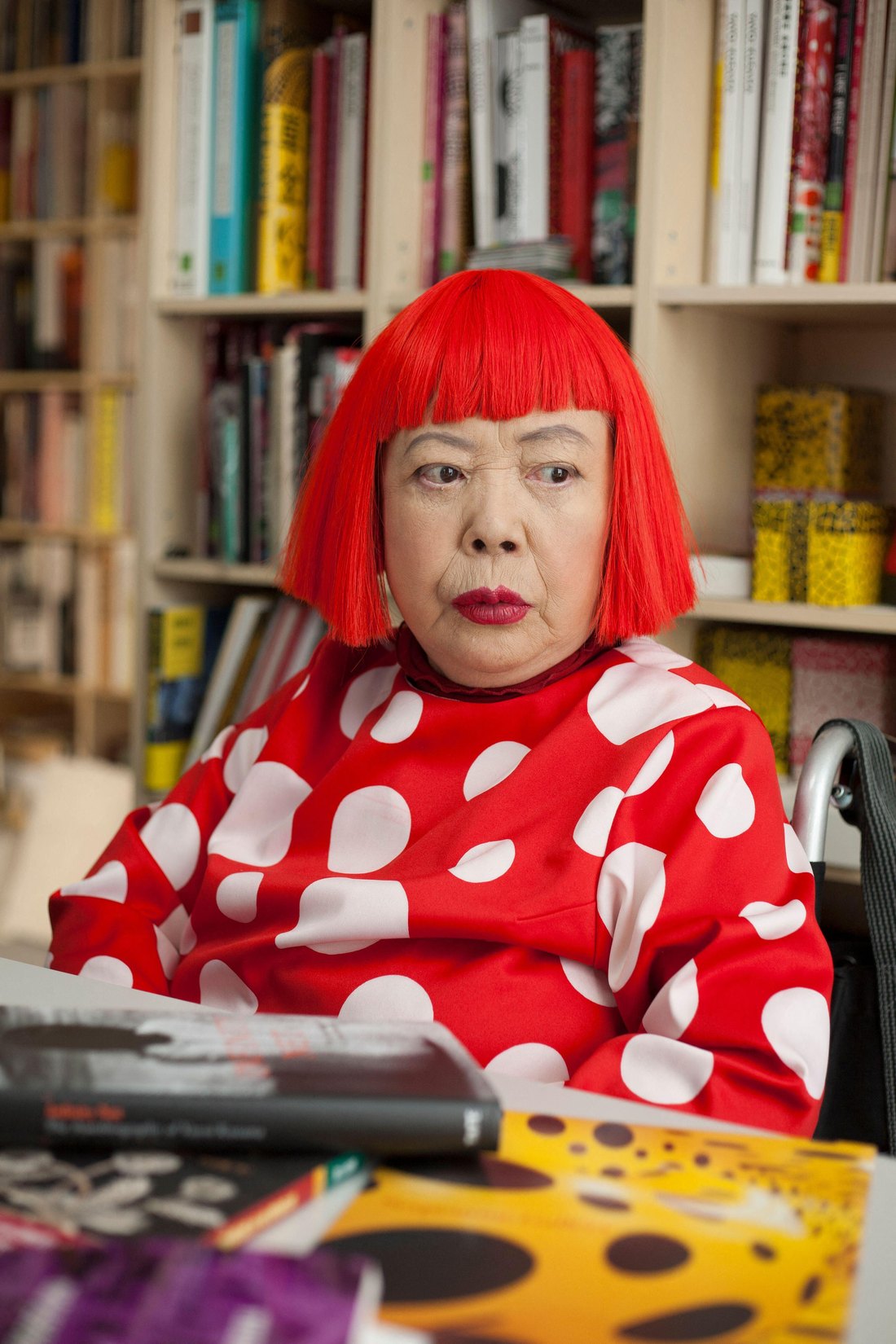
Kusama at work in her studio in Tokyo, 25 January 2012. She was 82, and had been living at Seiwa Hospital for thirty-five years. Photo: Jeremy Sutton-Hibbert/Alamy Live News.
Read the list of what she made from inside that arrangement and the word “confinement” starts to look like the wrong one. Nine novels and books of poetry between 1977 and 1990, with titles like Manhattan Suicide Addict and The Burning of St Mark’s Church. An autobiography, Infinity Net. Seven solo shows in the two years 1980 to 1981. The pumpkins, from 1983. Then the mirror rooms again, then the museums, then the queues.
“I fight pain, anxiety, and fear every day, and the only method I have found that relieves my illness is to keep creating art.”
Yayoi Kusama
The dots were never decoration. She was explicit about it, repeatedly, in language nobody put on a tote bag: “Polka dots symbolize disease.” And: “By obliterating one’s individual self, one returns to the infinite universe.”
Twenty-seven years later, they let her back into Venice
In 1993 Kusama was given the Japan Pavilion at the 45th Venice Biennale — the first woman to be given a solo presentation representing Japan. Women had represented Japan before, in group shows; a solo pavilion had been given before, to a man. The two things had never been put together until her.
She filled it with a miniature retrospective built around Mirror Room (Pumpkin), her first mirror room in over two decades. It was twenty-seven years since she had been moved off the lawn outside.

Hymn of Life — Tulips installed at the New York Botanical Garden, the Bronx, 28 October 2021. Photo: Nancy Kennedy / Alamy Stock Photo.
What followed was the second half of a career that most artists do not get at all. Love Forever: Yayoi Kusama, 1958–1968, organised by the Los Angeles County Museum of Art and the Japan Foundation with MoMA, toured from 1998 to 1999 and re-established her. A four-venue European and American retrospective ran through 2011 and 2012, taking in Tate Modern from 9 February to 5 June 2012. The Hirshhorn’s Infinity Mirrors in 2017 gave the Smithsonian its best spring since 1974. The Yayoi Kusama Museum opened in Shinjuku in October 2017, five storeys, timed tickets only.

A pumpkin sculpture by Kusama on display at the Round Pond, Kensington Gardens, London, 8 July 2024. Photo: Goddard on the Go / Alamy Stock Photo.
THE SCALE OF IT
What the queues looked like
HIRSHHORN, 2017
160,000
Visitors to Infinity Mirrors, 23 February to 14 May. The museum’s best spring since 1974.
MELBOURNE, 2024–25
570,537
National Gallery of Victoria retrospective.
COLOGNE, 2026
480,335
Museum Ludwig. It closed weeks before she died.
AUCTION RECORD
$10.5m
Untitled (Nets), 1959, at Phillips in New York, May 2022.
Sources: Smithsonian; The Art Newspaper; HENI.
And then the dots went into a shop window
In July 2012, with Marc Jacobs as creative director, Louis Vuitton put Kusama’s dots on ready-to-wear, leather goods and watches, timed to land days before her Whitney retrospective opened. In January 2023 it did it again, and much bigger: over 400 items, released in Japan and China on the 1st and worldwide on the 6th, the first time her work had appeared in the menswear line, with craftspeople developing a technique to make painted daubs look still wet.

A bag from the 2023 Louis Vuitton collaboration, with pumpkin charm, in the window of the Louis Vuitton store on Rodeo Drive, Beverly Hills, 15 April 2023. Photo: Larry Brownstein / Alamy Stock Photo.
It made her, in her dealer’s words on the day her death was announced, “without a doubt, the most famous living artist in the world.” That is David Zwirner’s assessment, and Zwirner sold her work, which is worth saying out loud.

A sculpture bearing Kusama’s likeness, erected on the rue du Pont Neuf in Paris beside the Louis Vuitton headquarters, 27 July 2023. Photo: Philippe Turpin / Photononstop / Alamy Stock Photo.
It also produced the sharpest criticism of her final decade, and an honest obituary has to carry it. Writing in Hyperallergic in 2023, Hindley Wang argued that the campaign put “the stereotypical mute and absent Asian woman… on display along the rank of commodity goods as part of a global marketing project,” and that her “literal containment within the psychiatric institution is corroborated by this animatronic artist in the shop window.” Georgina Adam of The Art Newspaper, quoted in ArtsHub, was blunter about the merchandise itself: “a dizzying blanket bomb of dots, dots and more dots.” Artnet’s obituary identifies a “growing chasm between Kusama, the icon, and Kusama, the woman and artist.”
Set the 2023 campaign beside the Venice lawn in 1966 and you have the two ends of the same life: a woman selling mirrored balls for two dollars to mock the art market, and a woman whose likeness stood in a shop window on the rue du Pont Neuf. She lived long enough to be both. Whether the second one was a betrayal of the first, or simply the market finally paying what it owed a woman it had ignored for twenty years, is a question worth arguing about, and we are not going to settle it in an obituary.
One further thing belongs on the record. Kusama’s autobiography contained derogatory language about Black people. She apologised in 2023, ahead of a show at SFMOMA. It resurfaced within hours of her death being announced, and it will be part of how she is assessed.
Ireland saw her once
Kusama has been exhibited in Ireland exactly once that we can find.
Where the Lights in My Heart Go (2016), one of her mirrored works, was included in Desire: A Revision from the 20th Century to the Digital Age at IMMA, Royal Hospital Kilmainham, from 21 September 2019 to 22 March 2020. It was co-curated by Yuko Hasegawa, artistic director of the Museum of Contemporary Art Tokyo, and Rachel Thomas of IMMA. She was billed alongside Duchamp, Ernst, Magritte, Tracey Emin and Genieve Figgis.
The run ended on 22 March 2020. Anyone in Ireland who meant to get to it in the last fortnight did not.
No Irish public collection is known to hold a work by her. There is no record of a Dublin activation for either Louis Vuitton collaboration; the animatronic figures and painted façades went to Paris, New York and Tokyo. Irish coverage of her death this week has been syndicated agency copy. The most globally recognisable artist of the last decade passed through the country once, for six months, in a group show, and left almost no trace on the record here at all.
In her own words
YAYOI KUSAMA
Six things she said
“Our earth is only one polka dot among a million stars in the cosmos.”
ON DOTS
“Polka dots symbolize disease.”
BOMB, 1999
“By obliterating one’s individual self, one returns to the infinite universe.”
BOMB, 1999
“I still see hallucinations even now. Dots come flying everywhere. And I paint them.”
2017, AGED 88
“I feel there is little left in my life, but I am now still fighting to the death for my art.”
ON RECEIVING THE ORDER OF CULTURE, 2016
“I will keep painting until I die.”
ASSOCIATED PRESS, 2012
What is being said
Her studio’s statement is the one every outlet has run: that she “pursued an internationally acclaimed career as a pioneering avant-garde artist” across “visual art, performance, fiction, and poetry,” that she painted to the end, and that those left will “carry forward Kusama’s wishes and, through art, continue to bring hope and strength for the future to people around the world.”
Hidenori Ota, who has represented her in Japan since 1988, said that helping bring her work to the world had been “an irreplaceable part of my life.” Alexandra Munroe, senior curator at the Guggenheim, said her stories “changed how the history of avant-garde art was written and understood.”
In Amsterdam, the Stedelijk Museum has turned its Kusama retrospective into a memorial. Its director, Rein Wolfs: “In her work, the distinction between yourself and the world around you disappears: you become part of something greater than yourself.” Its curator, Leontine Coelewij, on the fact that she was still making new work at 97: “a testament to her extraordinary artistic strength.”
In Matsumoto, the city she was born in, the municipal art museum has set up a table for flowers and opened its Kusama rooms to the public free of charge.
As of writing, there is no statement from IMMA, from any Irish gallery, or from any named Irish artist.
What she actually did
She took the worst thing that happened to her — a mind that would not stop generating pattern, that turned a tablecloth into a room and a room into a universe and left her, in her own word, obliterated — and she did not get cured of it and she did not get destroyed by it. She built rooms other people could stand in and feel a small, safe, ticketed version of the same thing.
Millions of people queued for that. Most of them had no idea what they were looking at. She did not seem to mind: “I am very happy and grateful that you have come to see my exhibition,” was the message she sent to the Hirshhorn crowds.
She once said that if, a hundred years from now, someone were to look at her work and think she had done some really good work, she would be satisfied. Art, she said, was a creed.
She painted until the fourteenth of August. Then, for twelve days, nobody was told, and the queues went on forming outside a mirrored room in Cincinnati as though nothing had happened.
HOW THIS PIECE WAS SOURCED
The death, date, age and cause are confirmed by the joint statement from Yayoi Kusama Inc. and Yayoi Kusama Studio Inc. on the artist’s official site, by NPR (which gives multiple organ failure, via David Zwirner), and by Tokyo Art Beat, Artnet and The Art Newspaper. Biographical detail is drawn from Tate, the National Gallery of Victoria, M+, the Judd Foundation, the Georgia O’Keeffe Museum archives, the Japan Foundation’s official record of the Japanese pavilion at Venice, MoMA’s 1998 press release, Smithsonian, Sotheby’s and the American Psychiatric Association’s journal. The Irish exhibition record comes from IMMA’s own exhibition and press pages, cross-checked against e-flux and Tokyo University of the Arts. All photographs are licensed through Alamy and credited individually.
Two figures circulating this week we have not printed. An Alamy caption distributed with file photographs gives her age at death as 79; she was 97, and the same caption gives her birth year as 1929. And no source we could find offers any explanation for the twelve days between her death and its announcement, so we have not offered one either. We have also not repeated the widely quoted line about Venice officials objecting that she was selling art “like hot dogs”, which we could not trace to any contemporary account of 1966.
You Might Also Like
The latest from The Moiré Edit.