Woven in Donegal, Made in Morocco
Irish heritage cloth still carries a place name. Increasingly the garment is finished somewhere else - and the label rarely says so.
One sentence on the Magee 1866 website tells you more about Irish heritage clothing than any amount of windswept-coastline marketing. The fifth-generation Donegal house, founded in 1866, weaves its cloth by the River Eske. Its garments, it says plainly, are "manufactured with trusted partners in Europe, Morocco, Turkey, India". Its own navigation draws the line: tweed pages headed Woven in Donegal, menswear pages headed Designed in Donegal.
That difference — woven versus designed — is the most useful thing anyone can hand you before spending €400 on an Irish jacket. Neither claim is dishonest: Magee's cloth is genuinely Irish, and the company stopped making clothes in-house in 2007. But both sit under one heritage banner, and a shopper skimming for "Donegal" will not separate them. An Ennis blazer is €385 to €425; the handwoven Milltown, €549.
The name is about to become legally defensible
This matters more in 2026 because Donegal tweed is trying to protect itself. The Donegal Tweed Association — chaired by Patrick Temple of Magee's mill, with Molloy & Sons, McNutt, Studio Donegal and Eddie Doherty's handwoven tweeds — is pursuing Protected Geographical Indication status under the EU's craft goods regime. Some 250 people work in the industry across south-west Donegal; the threat is imitation cloth woven in Britain, Italy and China and sold as Donegal.
Kieran Molloy put the standard bluntly to RTÉ: something should only be called Donegal tweed "if it has been designed, warped, woven, inspected and dispatched in Co Donegal". The application has not yet cleared the Irish IP Office and the EUIPO. Until it does, the word describes an aesthetic — herringbone, the slubby Donegal fleck — not a place.
The weavers who do it all under one roof
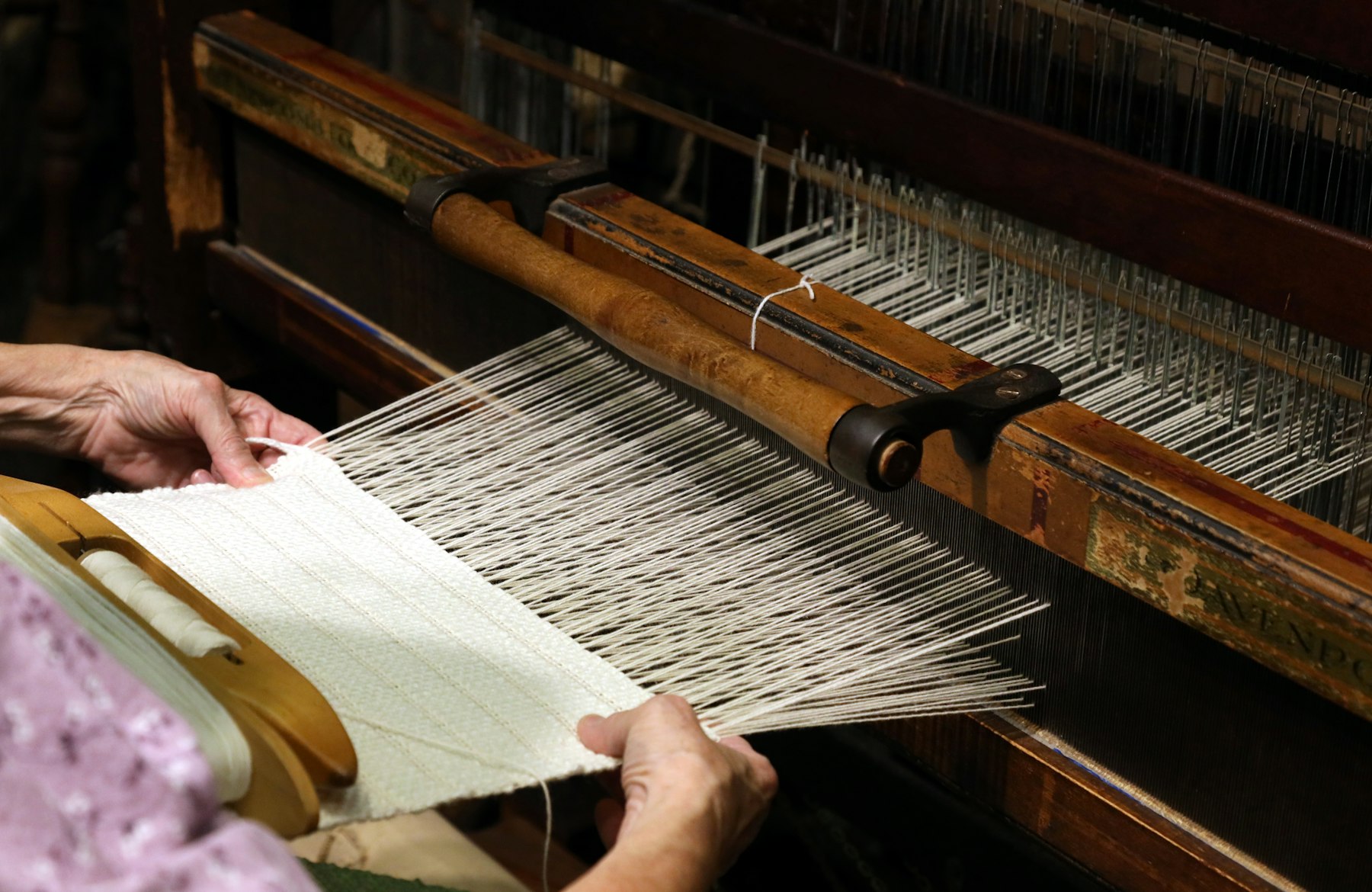
For cloth whose whole chain sits in the county, look to the small houses. Molloy & Sons in Ardara are sixth-generation weavers, tracing back to Edward Molloy in the nineteenth century. Yarns are spun and dyed locally; colour matching, designing, warping, weaving and dispatch are all in-house. Throws run €195 for a textured Donegal tweed, €220 for the Maghera and €225 for the basket weave — the cheapest way to own properly provenanced Irish cloth.
Studio Donegal in Kilcar is the purist's choice: everything carrying the label is hand-woven and made in the Kilcar mill, which cards and spins on site and deliberately abandoned machine weaving. Around fifteen people work there under Tristan Donaghy, whose parents Kevin and Wendy took the business into private ownership in 1987. The Carrick jacket is €529, an Aran vest €239, the Atlantic hat €145.
McNutt of Donegal, weaving in Downings since 1953, works in lambswool, merino, cashmere, alpaca, linen and tweed, and sells scarves through the V&A shop. In Wexford, Emblem Weavers was founded in 1962 by Jim Conway, who began at fifteen with two secondhand looms and a yarn winder built from a bicycle wheel in a Dublin basement; his sons Seamus and Stephen weave colour-woven Irish linen for international ready-to-wear houses.
Kerry Woollen Mills at Beaufort has been in the Eadie family since 1904 — the fourth generation — on a site milled for three hundred years off the River Gweestin; a lambswool Celtic stole is €44.95, a Killarney blanket €189. Foxford Woollen Mills, founded in Mayo in 1892 by Mother Agnes Morrogh-Bernard as an anti-poverty scheme, still weaves on site and employs over seventy. Crucially, Foxford states that its wool comes from Australia and New Zealand, spun by specialists in the UK and Ireland, while bed linen and homeware are bought in — the disclosure the rest of the sector should copy.
Inis Meáin: the strangest business in Irish fashion
Fifty years ago Tarlach de Blácam, a Trinity graduate in Celtic languages, and Áine Ní Chonghaile, an island native and teacher, began knitting on Inis Meáin — without electricity or running water, ferrying garments ashore by currach. It remains the only knitting factory on the Aran Islands. Their son Ruairí and his wife Marie-Thérèse took over in January 2023.
The numbers are counter-intuitive. Twenty-five employees, five with over thirty years' service, producing 7,500 to 8,000 pieces a year — roughly half what the company once made. Yarn comes from Biagioli Modesto in Florence at €100 to €200 a kilo, six cones to a sweater, knitted on Shima Seiki machines. Just over half of production goes to the United States; online sales have risen from 12 per cent of revenue in 2023 to about half today, alongside Mr Porter, Todd Snyder and Brown Thomas.
So: knitted on an Aran island, from Italian and South American yarn. Inis Meáin says so openly, which is the point. The lambswool Ridges Aran is €565, the Máirtín Beag Galánta €625, the cashmere Boatbuilder €695, a full-cashmere Aran €1,345. Tarlach and Áine took the Lifetime Achievement Award at the 2024 Irish Made Awards.
Whatever you do, make it beautiful.
Áine's instruction has aged better than most brand strategies.
Knitwear: who actually knits here
IrelandsEye Knitwear is the clearest modernisation story. Started in 1988 by Jim O'Sullivan in a Dublin garage with six family members, it now runs a 30,000 sq ft factory in Baldoyle across three generations, employing over fifty. Panels are machine-knit, then hand-stitched, hand-finished and hand-steamed. The Blasket merino Aran is €119.95, cashmere-mix cables around €149.95 — honeycomb and cable done properly, at a price a normal person can pay.
Carraig Donn, founded in Westport in 1965 by Máire and Pádraig Hughes, is now a 43-store retail group owning Aran Woollen Mills in Mayo — Ireland's largest knitwear plant, exporting around 60 per cent of output. Judge the knitwear on the label, not the shopfront.
Aran Sweater Market, founded on Inis Mór and trading on "the famous original since 1892", warrants most caution. Its copy says sweaters are "made with love in Ireland" by "the best Irish knitters", while its FAQ says they are "usually hand knitted" — a hedge worth noticing. The Inisheer merino Aran, in honeycomb and cable, is listed at $89.95 and labelled made in Ireland. At that price: machine-knit, from merino that never met an Irish sheep.
What we could not verify
Several things. Aran Sweater Market does not publish its ownership, which ranges are hand-knitted, or where its merino originates — "local wool" and "merino" cannot both be true, as Ireland has no merino flock. IrelandsEye's Dublin manufacturing is well documented; its yarn origin is stated nowhere we could find. Molloy & Sons say six generations; one long-standing profile says five. Triona of Ardara took Excellence in Craftsmanship at the Ireland Fashion Week Awards in March, and its founding family is documented, but no source confirms whether its tweed is handwoven on site.
On the runway: Magee 1866, IrelandsEye and Triona all appeared in the Irish Roots show at Slane Castle in October 2025. Ireland Fashion Week 2026 runs 7–12 October across eight shows including Heritage and Modern Heritage — but we found no published 2026 line-up naming them. Treat their return as likely, not confirmed.
The buying advice is unglamorous. Cloth is easier to verify than clothes: a Molloy throw or a Studio Donegal jacket carries its provenance with it, while a blazer's fabric and its tailoring may be separated by three thousand miles. Ask where a thing was woven and where it was sewn, as two questions. The houses that answer both without flinching — Studio Donegal, Molloy, Inis Meáin, Foxford — keep the skill in the country, and not coincidentally charge what it costs.
You Might Also Like
The latest from The Moiré Edit.