Lisbon: The Seven-Hilled City That Refuses to Be Rushed
Tiled façades, custard tarts still warm, and a melancholy beauty all its own. How to do the seven-hilled city properly in 2026 — including which viewpoint to skip and which museum is shut.
Lisbon is a city built on a misunderstanding of its own geography. A friar called Nicolau d'Oliveira wrote in about 1620 that it stood on seven very high hills, borrowing the Roman idea wholesale, and the description stuck so firmly that nobody has been able to shift it since — despite the hills being neither seven nor especially obvious once you are among them. What is true is that the city goes up and down constantly, that this is why the light is so good, and that no amount of planning survives the first flight of steps.
It is also a city under real pressure. Lisbon has become one of Europe's most visited capitals in about a decade, and the strain shows in queues, in rents and in the particular exhaustion of a place that has learned to perform for outsiders. The trick to enjoying it — and to not making it worse — is to move slightly off the obvious line. Here is how.
The viewpoints — and the one to skip
The miradouros are the city's real public rooms. Nossa Senhora do Monte in Graça is the best of them and the highest point in central Lisbon — Baixa, the castle, the river and the bridge all at once, and worth setting an alarm for. Portas do Sol gives you Alfama's roofs tumbling to the Tejo; it is the most photographed and always busy, but big enough to absorb it. São Pedro de Alcântara in Bairro Alto is the classic postcard — but it faces east, so do not go there for sunset. For that, Santa Catarina, with the Adamastor statue and a crowd that turns it into an outdoor party.
The one to skip is Santa Luzia. The setting is beautiful and it has been comprehensively ruined by the volume of people passing through. Go at sunrise or go instead to the Miradouro do Recolhimento nearby. And if you want a view with almost nobody in it, Santo Amaro in Alcântara looks straight at the Ponte 25 de Abril; the climb up to it does the crowd control for you.
Tram 28, honestly
Yes, ride it. No, not the way most people do. The 28 runs Martim Moniz to Prazeres via Graça, Alfama, Baixa, Chiado and Estrela, and the queue at Martim Moniz routinely runs past thirty minutes. Two better options: go between seven and eight in the morning or after seven in the evening, or board westbound at Praça Luís de Camões heading for Campo de Ourique, where you stand a chance of a seat.
On fares — a single bought on board is €3.30, which is the tourist price. Put Zapping credit on a Navegante card and the same ride is €1.72. A 24-hour unlimited ticket is €7.25 and is only sold at metro stations. Trams run 06:00 to 23:30 on weekdays, to 22:30 at weekends, every ten minutes at peak, and unpredictably the rest of the time.
One warning, and it is not squeamishness: the 28 is the most reliable pickpocketing route in Portugal, concentrated at boarding and exit and in the crush. Nothing valuable in a back pocket, bag in front, and be alert at the doors.
For the tram experience without the scrum, locals take the E24 from Praça Luís de Camões to Campolide — traditional, quiet, rarely crowded — or the E12, which covers part of the 28's route with a shorter wait.
The street queue at Pásteis de Belém is almost always takeaway only. Walk past it, and go straight inside.
Belém, and the tart
Mosteiro dos Jerónimos is €18 and worth it — a UNESCO site built under Manuel I between 1495 and 1521, and the high-water mark of Portuguese Gothic. The cloister opens Tuesday to Sunday, 09:30 to 17:30, with last entry at 17:00 and the ticket office shutting at 16:30. The church keeps separate hours: 10:30 to 17:00 Tuesday to Saturday, and only from 14:00 on Sundays. Closed Mondays.
Torre de Belém is €15, also UNESCO, also closed Mondays, open 09:30 to 17:30.
Then the tart. Pásteis de Belém has been on Rua de Belém since 1837, working from a recipe out of the Jerónimos monastery, and it is the only place on earth legally entitled to call the result a pastel de Belém rather than a pastel de nata. Expect around €1.50 each, about €9 for a box of six.
Here is the tip that changes the visit: the enormous queue on the street is almost always the takeaway line. The confeitaria behind it seats over a thousand people across a warren of tiled rooms, and you can usually walk straight in. Weekday mornings before nine, or after six in the evening, are quietest.
Alfama and fado
Fado went onto UNESCO's Intangible Cultural Heritage list in 2011, and the Museu do Fado in Alfama will give you the history. For the thing itself, choose your register.
Serious rooms: Clube de Fado in Alfama, open nightly with established names and newer singers; Mesa de Frades, an eighteenth-century chapel lined with baroque azulejos, where you book ahead or chance your arm around midnight; Sr Vinho in Lapa. Dinner-and-show runs roughly €50–80 a head; a shorter theatre-style performance is €10–20.
For fado vadio — amateur, unbooked, sung by whoever stands up — try Tasca do Chico (cash only, go early), A Baiuca, or Tasca do Jaime in Graça on a weekend afternoon.
The etiquette is absolute and worth respecting: silence while anyone is singing. Phones away. No flash. If you cannot manage that, go to a bar instead.
Markets, factories and one closed museum
Time Out Market opened in 2014 in half of the Mercado da Ribeira — the other half is still a working fish, fruit and vegetable market — with around 36 kitchens including Henrique Sá Pessoa, Miguel Castro e Silva and Marlene Vieira. It was drawing close to four million visitors a year by 2018. It is not a secret and it is still good; go at an odd hour.
LX Factory in Alcântara is a mid-nineteenth-century textile complex reborn in 2008 as a creative quarter under the Ponte 25 de Abril. Shops and cafés run roughly 10:00 to 19:00, bars until midnight and later at weekends, and the LX Market fills the back car park every Sunday, around 10:00 to 18:00. Go for Ler Devagar, the bookshop in a former printing works with the original press still standing on the upper floor. Tram 15 from Praça da Figueira to Calvário, then three minutes on foot.
One thing to know before you plan a tile pilgrimage: the Museu Nacional do Azulejo is closed. It shut on 1 November 2025 for major refurbishment under Portugal's recovery-plan funding, and no reopening date has been announced beyond “as soon as possible.” The collection is browsable online in the meantime. For tiles in the wild, walk Alfama, Graça and Príncipe Real and look up.
Sintra, and how to survive it
Sintra is a half-hour train ride and a world away — a damp green micro-climate full of Romantic follies. Pena Palace and Quinta da Regaleira are the two most people come for, and both now operate on timed entry that genuinely sells out in season. Book before you travel, not at the gate, and pick the earliest slot going.
The mistake everyone makes is trying to do Pena, Regaleira and the Moorish Castle in one day. Do two properly and leave the third. And if you want the Romantic-ruin atmosphere without the coach traffic, Regaleira in the first hour of the day is one of the great European experiences.
When to go
March to May and late September into October. Summer is hot, full and expensive; August adds Portuguese holidays to everything else. Winter is mild, cheap and often bright, and the city belongs to the people who live in it.
Which is the note to end on. Lisbon's tourism boom has real costs for Lisboetas — rents, short lets, streets reorganised around visitors. Stay in a hotel rather than an apartment, eat where the menu is not in five languages, and take the E24 instead of adding another body to the 28.
The verdict
Lisbon rewards the slow visitor and punishes the checklist. Give it four days, walk more than you planned, take the funicular when your legs go, and spend one evening in a room where everyone stops talking because somebody has started to sing.
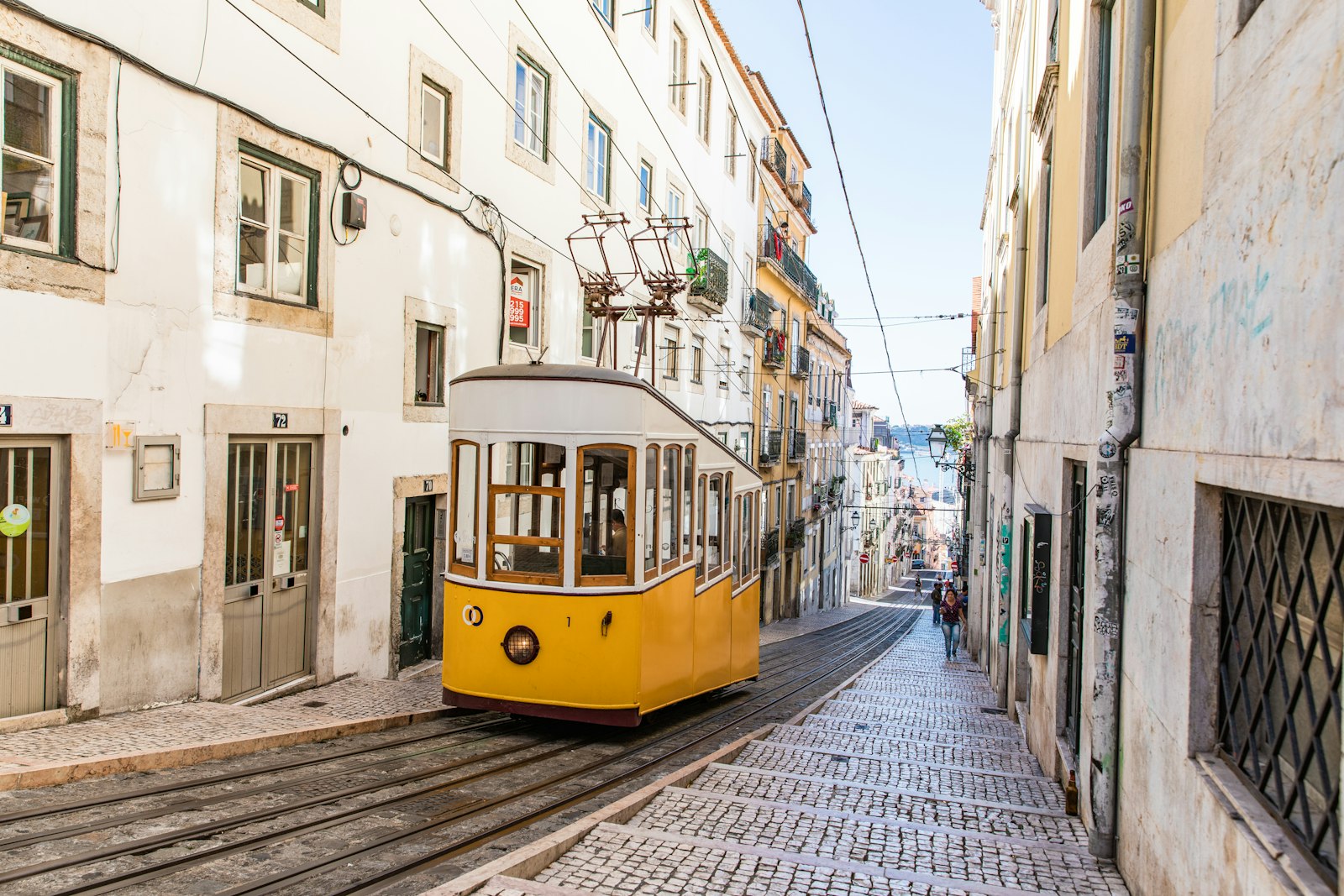
Photograph: the Elevador da Bica by André Lergier on Unsplash.
You Might Also Like
The latest from The Moiré Edit.