Irish Millinery Beyond the Racecourse
Ireland's milliners have published prices, imported blocks and no degree course - a real craft trade the country photographs once a year, on a Thursday in July.
Irish millinery is written about once a year, in late July, in photographs taken at Ballybrit. That framing is bad reporting. Hat-making in Ireland is a technical trade with defined materials, a specific tool set, an apprenticeship problem and a customer base only partly made of racegoers. The racing calendar is its biggest cash event, not its whole market. What follows is limited to what could be verified from primary sources in August 2026 — less than the annual coverage implies.
The people actually making hats
Philip Treacy is the name that distorts everything. Born in Ahascragh, Co. Galway in 1967, he studied at the National College of Art and Design from 1987 and took a Royal College of Art scholarship in 1988, graduating with first-class honours in 1990. Showroom in 1991; boutique at 69 Elizabeth Street, Belgravia in 1994; British Accessory Designer of the Year five times (1991, 1992, 1993, 1996, 1997); an OBE in 2007; 37 hats for the 2011 royal wedding; a royal warrant from Queen Camilla in 2024. His site is live, carries a 2025 copyright line and publishes no prices: Spring/Summer 25 is a gallery of 91 pieces with no shop attached. He is a London business and has been for thirty-five years.
The milliners working in Ireland are smaller and easier to miss. Margaret O'Connor works from the Burren in Co. Clare, trained under Treacy, Noel Stewart and Yvette Jelfs, was Milliner of the Year at the 2014 Irish Fashion Innovation Awards and had a hat taken into the National Gallery of Ireland collection in 2018. Carol Kennelly runs a studio in Tralee, Co. Kerry, sells more than 150 finished pieces online and ships worldwide. Aoife Kirwan works by appointment from Portlaoise, Co. Laois, is stocked at Marion Cuddy in Dublin's Powerscourt Townhouse Centre, and trained in millinery at London College of Fashion and privately with Thomas von Nordheim. Martha Lynn is the pattern in miniature: fine art at IADT Dún Laoghaire, millinery under Aileen Keogan at the Grafton Academy, internships with Treacy and Stephen Jones, a first studio in Dublin — and a business now run from London.
What the craft actually is
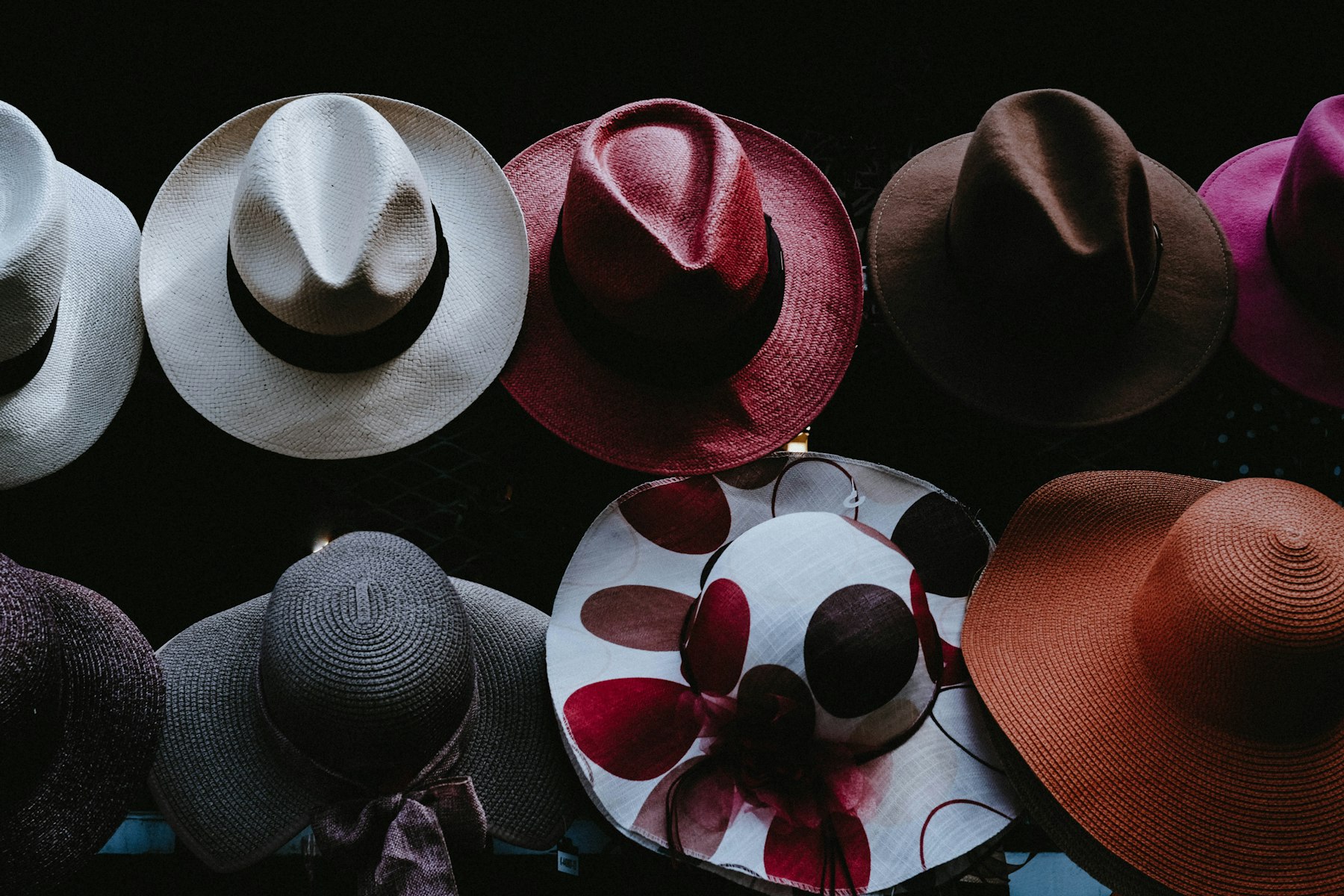
Three materials do most of the work. Fur or wool felt arrives as a hood or capeline — a cone or a wide-brimmed blank — and is steamed onto a block. Parasisal (also spelled parisisal) is a fine plaited straw hat body. Sinamay is a woven abaca cloth sold by the metre, stiffened or textured, and is behind most of what the public calls a fascinator.
The shaping tool is a hat block: a carved wooden form. The maker steams the material, pulls it over the block and holds crown and brim edge with blocking string, push pins and a hammer until it dries hard. Then stiffening, wiring the brim edge, stitching, trimming, finishing.
Almost none of the supply chain is Irish. Guy Morse-Brown of Bromham, Wiltshire is the standard block source, hand-cutting to order with no online ordering and no published prices. Materials come from British suppliers such as Parkin Fabrics in Oldham, where wool felt hoods start at £10.49 and cashmere capelines at £24.50. An Irish milliner is an importer before she is anything else.
Where you learn it, and where you cannot
There is no degree-level millinery course in Ireland. NCAD's continuing education certificates cover photography, jewellery, drawing and visual culture — no millinery. The Design and Crafts Council of Ireland's public craft categories run from ceramics to textiles; millinery is not among them, though milliners hold DCCI membership.
What exists instead is short courses and one-to-one tuition. The Grafton Academy — founded in 1938 by Pauline Elizabeth Keller Clotworthy, at 12 Richmond Row, Dublin 8, and due to move on 2 April 2026 — runs millinery as six classes, Tuesday evenings or Saturday afternoons, for €380; students learn, in its words, "the skills and techniques used to block and shape straws and felt hoods." Aoife Kirwan teaches a four-day felt, parasisal and sinamay course at her Portlaoise studio for €600, over two consecutive weekends, with a 50 per cent non-refundable deposit; the studio supplies blocks, steamer and tools, the student buys fabric.
Beyond that, the route is the one Treacy, Lynn and Kirwan all took: leave.
The price of a hat
Published prices are more consistent than the trade's mystique suggests. O'Connor's shop runs from about €85 for small headwear to €1,400 for a large sculptural piece, with mid-range work at €320–€360. Kennelly's range runs €75 for a birdcage veil to €895 for her largest hats. Lynn's London ready-to-wear runs £435 to £975, with a four-week minimum on commissions.
The competition is not another milliner. It is Brown Thomas, whose hats category in August 2026 ran €45 to €560, included Phase Eight fascinators at €65–€89, and listed no Irish milliners at all. The gap between an €80 factory fascinator and a €400 blocked hat is the whole commercial problem of the craft here.
The racecourse as engine
The Galway Races Summer Festival ran from Monday 27 July to Sunday 2 August 2026 at Ballybrit. It has been a seven-day meeting since 1999 and draws over 150,000 people — 122,000 in 2023, 116,000 in 2022. Ladies' Day is the Thursday. In 2026 Lisa Walsh was named Best Dressed and Maksuda Akhter took Best Hat, both sponsored by Ella & Jo.
Punchestown, five days each April, and the Dublin Horse Show at the RDS each August — its 150th edition ran in 2025 — complete the season. That compression is the point: a maker's year is weighted into a handful of weeks, and cash flow outside them is thin.
Where the hats go afterwards
Bridal is the steadier trade. Kennelly categorises stock by Bridal and Mother of the Bride; Kirwan sells bridal only by studio consultation. Export is real but individual: Kennelly ships worldwide, and Ascot's Royal Ascot Millinery Collective, launched under creative director Daniel Fletcher, commissions twelve hats from makers in Dubai, New York, London and Ireland. Institutional work is a third channel — O'Connor's place in the National Gallery collection is an acquisition, not a race day.
What we could not verify
- Trading status for milliners routinely named in Irish coverage — Suzie Mahony, Edel Ramberg, Jennifer Wrynne. No primary site could be reached for any, so none is named above as active — which is not evidence of closure.
- Hat hire pricing in Ireland. No hire business site could be reached, so the comparison above is bespoke against high street, not against hire.
- Kennelly's listed place in the Royal Ascot Millinery Collective for 2026 — on her own site only; Ascot's page returned an earlier edition.
- Martha Lynn's stockist list. Her site names Harvey Nichols, Brown Thomas, Selfridges and Fortnum & Mason; Brown Thomas's own hats category did not list her.
- Prize values for the Galway awards, 2026 Dublin Horse Show dates, and any figure for millinery's economic contribution.
- No first-person quote from a working milliner could be sourced to a document we fetched, so none appears above.
Irish millinery is a real craft with a documentation problem. The techniques are verifiable, the prices published, the training short-course and private, the supply chain routed through Wiltshire and Oldham. What is missing is the middle: no third-level route, no trade-body listing, no sector figures, and a retail floor set by €65 imported fascinators. Ladies' Day is not the distortion. The absence of everything around it is.
You Might Also Like
The latest from The Moiré Edit.