Ireland's Secondhand Economy
Separate textile collection became law in January 2025 and Vinted's GMV hit EUR 10.8bn, yet Ireland reuses only 4,660 tonnes of clothing a year.
Ireland now has two secondhand economies, and only one of them is visible. The first is a bulk waste-handling operation that moves tens of thousands of tonnes of used clothing out of the country every year. The second is what people mean by "the vintage scene" — Temple Bar rails, kilo sales, consignment counters, a Vinted app open on the bus. On the official numbers, the second is a rounding error inside the first. That gap is the most interesting fact about Irish resale in 2026.
The law changed on 1 January 2025
The obligation is European and unambiguous. Directive (EU) 2018/851, amending Article 11 of the Waste Framework Directive, states that "Member States shall ensure that, by 1 January 2025, textile waste is separately collected." Ireland's public waste service confirms the position: "Since January 2025, Ireland has been required to provide separate collection for unwanted textiles."
Note what the rule does not do. It requires textiles to be collected apart from residual waste. It does not require that they be reused, that they be reused in Ireland, or that any domestic resale target be met. Separate collection is plumbing, not outcome.
The numbers are much smaller than the conversation
Ireland discards "around 110,000 tonnes of textiles as waste every year and nearly all are processed via waste-to-energy plants or landfill." About 64,000 tonnes of that goes into household bins. A further 57,000 tonnes is collected separately through textile banks, commercial collectors and charity donations.
Of that separately collected stream, mywaste.ie states that 44,500 tonnes are reused, 15,000 tonnes are recycled into "rags, fibre and other materials" — and that 1,500 tonnes are reused through vintage and online resale.
Fifteen hundred tonnes, against 110,000 tonnes discarded. The entire visible resale culture of this country handles on the order of one to two per cent of what Ireland throws away.
The Environmental Protection Agency, using household survey data gathered with the Central Statistics Office, puts the domestic figure lower still. Its national reuse statistics for 2024 put textile reuse at 4,660 tonnes. Total reuse across all categories was 83,400 tonnes, or 15.5 kilograms per person, with furniture at 38,300 tonnes dwarfing clothing. The national target is 20 kg per person per annum by 2030.
Here is the uncomfortable trend line. EPA's amended per-capita reuse figure for 2021 was 15.9 kg. For 2024 it is 15.5 kg. Over the years when resale supposedly went mainstream, measured reuse per head in Ireland did not rise.
Charity retail is the actual infrastructure
Strip away the branding and Ireland's secondhand network is mostly charity shops, and has been for decades. The Society of St Vincent de Paul says it runs "over 230 local Vincent's charity shops located in every county around Ireland." Vision Ireland — the former NCBI — lists "+130 shops nationwide" and claims that "95 per cent of clothing donated to us is recycled or sold on for reuse." Enable Ireland's shop finder lists 29 stores. Oxfam Ireland's locator shows 44 shops across the Republic and Northern Ireland, including six in Dublin, two in Cork and single sites in Galway, Limerick and Waterford.
That is several hundred shops with reliable donation intake, in towns no vintage dealer would open in. It is also where the export flow starts: charity bins and textile banks feed the same graders that ship abroad.
Vinted is the volume; Dublin's shops are the culture
Vinted operates a dedicated Irish storefront at vinted.ie. Its 2025 results, published 9 April 2026, show gross merchandise value of €10.8bn, up 47 per cent on 2024's €7.3bn; revenue of €1.1bn, up 38 per cent from €813m; and net profit of €62m, down 19 per cent from €77m. The growth is being bought.
To make second-hand first choice, we know what we need to do: we need to be the most cost-efficient, be the most reliable and easy to use. — Thomas Plantenga, CEO of Vinted
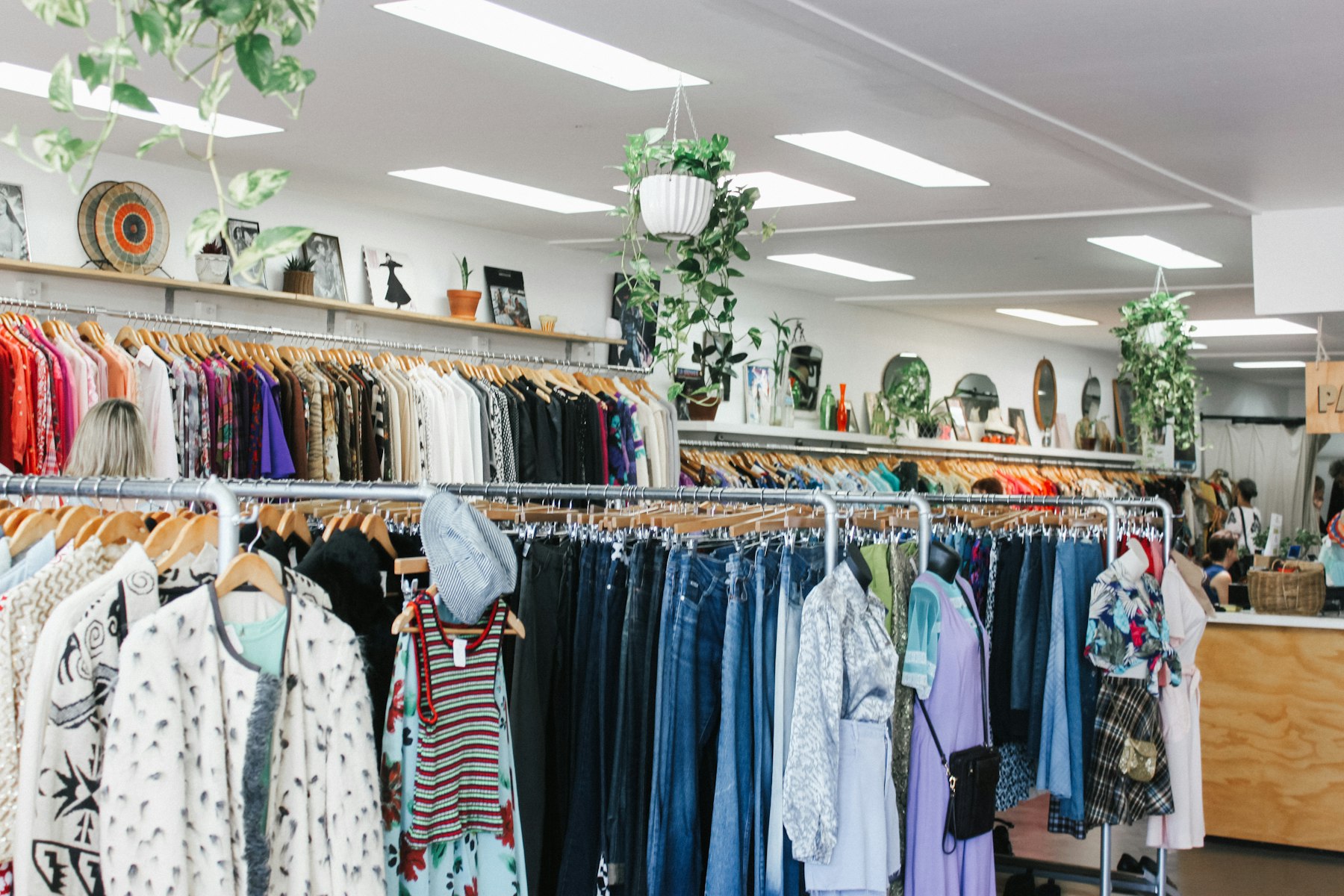
The physical trade is a different business entirely. Tola Vintage trades from 10 Fownes Street Upper in Temple Bar, with a second site, Tola Designer Vintage, at 12 College Green. Its rummage sales price jackets and coats at €10, tracksuit bottoms at two for €8 and other items at €5 — the closest thing to a kilo sale verifiable from a trader's own site.
Siopaella, a few minutes from Grafton Street, runs the other model: consignment and authentication for designer bags and accessories, with sellers submitting items for assessment before they reach the floor. Resale as a valuation service, not a rail to rummage.
Displacement remains unproven
Vinted argues that resale is replacing new buying, on the basis of its own survey of roughly 50,000 members across nine European markets, published in May 2026: 88 per cent of buyers check Vinted before buying new, and 76 per cent of purchases "avoided buying something new." It puts member savings at €21.6bn on adult fashion in 2025, at prices averaging 72 per cent below retail.
Treat this as marketing with a methodology attached. It is self-reported and self-commissioned, and the nine markets are not named, so whether Ireland is in the sample is unknown. Self-reported avoidance is the weakest evidence for displacement there is: nobody remembers the purchase they didn't make.
The harder Irish evidence points the other way. EU textile consumption rose from 17 kg per person in 2019 to 19 kg in 2022. Ireland still discards around 110,000 tonnes a year, almost all burned or landfilled, and domestic per-capita reuse has been flat since 2021. Resale is growing enormously as a business while sitting alongside new consumption rather than eating it.
What we could not verify
- Nine Crows. Its website sits behind a JavaScript redirect that could not be read. We could not confirm whether it is trading in 2026, and assert nothing either way.
- Dublin Vintage Factory. The domain resolves and its metadata describes a Temple Bar location, but no address, hours or contact page could be retrieved. Lucy's Lounge and Fresh Vintage: no live website found for either. All three unconfirmed.
- Cork and Galway independents. No trader in either city could be verified from a primary source, so none is named. This piece is Dublin-weighted as a result — a limitation, not a judgement about those scenes.
- The mywaste.ie arithmetic. Its stated components (44,500 tonnes reused plus 15,000 tonnes recycled) exceed the 57,000-tonne separately collected total, and the phrase "6% in Ireland and 21% exported" does not reconcile with 44,500 tonnes on any reading. Figures quoted as published; the inconsistency is the source's.
- Ireland-specific platform data. Vinted publishes no Irish user numbers; no verified Depop Ireland figures were found.
- Money. No verified turnover figure exists for Irish charity retail or the vintage trade as a sector, and Siopaella does not publish its consignment split. Anyone quoting a euro value for "Ireland's secondhand economy" should be asked for a source.
- Vision Ireland's retail page says its shops are "open again," phrasing that may predate 2026, though the 130-plus count is from its current site.
Ireland's secondhand economy is real, large and growing, and almost none of that growth is happening in the part of it with a shopfront. Vinted's global GMV was €10.8bn last year; Irish domestic textile reuse, on EPA figures, ran to 4,660 tonnes. Separate collection since January 2025 has improved how Ireland sorts its clothing waste without yet reducing it. Buying secondhand is still better than buying new. It is not yet evidence that anyone is buying less.
You Might Also Like
The latest from The Moiré Edit.