Dolly Parton, 1946–2026: The Woman Who Knew Exactly What She Was Doing
She refused Elvis, kept her copyrights, built an industry in the county she was born in, and let the world underestimate her for sixty years. Dolly Parton has died at 80 — and the free books are still going out in Tallaght and Cork this month.
Dolly Parton died peacefully in Nashville on Tuesday, at the age of 80.
The announcement came from her nephew and longtime head of security, Bryan Seaver, posted to her own social media accounts. No cause of death has been given. At her request there will be a small private service for immediate family, and the family have asked that anyone wishing to mark her death do so by donating to her Imagination Library — the scheme that has been posting free books to children in Tallaght since 2019 and in Cork since 2020.
The statement released in her family's name describes "a rhinestone life that shone bright enough for the world to see." It is a good line, and she would have approved of it, because she spent sixty years insisting that the rhinestones were the point.
“Sadness lies with us, not with Dolly”
The announcement came as a two-minute video posted to her own TikTok and Instagram accounts, captioned simply: A message from the family of Dolly Parton. In it her nephew Bryan Seaver — her manager and head of security for decades — speaks straight to camera against a plain black backdrop.
“It is an honor,” he begins, “an honor that is mixed with absolute pride and great sadness. But sadness lies with us, not with Dolly.”
He describes an aunt who “never saw a door she couldn’t open, and the doors she opened made and changed history,” and says that “by her example, we believed that anything was possible.” Then comes the line that has travelled around the world since.
“Dolly called me and said she wants to rest in a beautiful bed of plush cotton because after a life wearing heavy rhinestones, she finally deserves to be comfortable and have some rest.”
Bryan Seaver, her nephew, announcing her death
He signs off: “Rest in peace, Aunt Dolly, Aunt Granny, Gigi.”
@dollyparton A message from the family of Dolly Parton. original sound - Dolly Parton
Within hours the video had been watched more than nine million times. The President ordered flags across the United States lowered for a week.
The most underestimated woman in America, on purpose
Almost every obituary published today will say that Dolly Parton was more than her image. This is meant kindly and it is the wrong way round.
The image was not a distraction from the work. It was the work — the most sustained, most deliberate and most commercially successful act of self-construction in twentieth-century popular music, built by a woman who understood before almost anyone else that being underestimated is a competitive advantage you can manufacture.
She was explicit about it from the beginning. Sitting opposite Barbara Walters in 1977, asked whether she minded being a joke, she gave an answer that has aged into something close to a manifesto.
“I would never stoop so low as to be fashionable. That’s the easiest thing in the world to do.”
Dolly Parton to Barbara Walters, 1977
In the same conversation she explained the strategy without apology: "I just decided to do something that would at least get the attention. Once they get past the shock of the ridiculous way I looked and all that, then they would see there was parts of me to be appreciated."
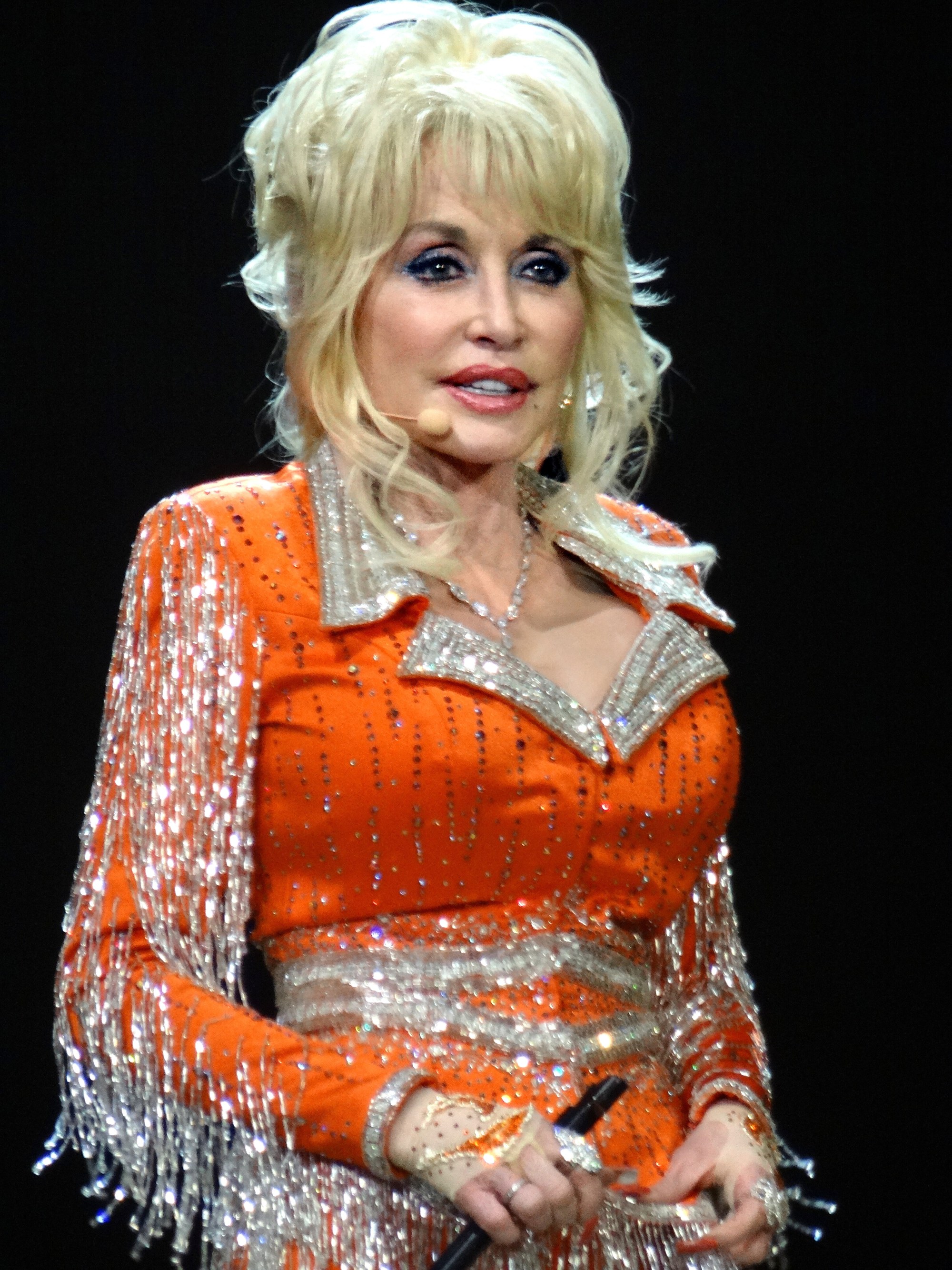
The look itself she always credited to a specific woman in Sevierville. "The way I look was really a country girl's idea of what glamour was," she told Rolling Stone in 2003. "I patterned my look after the town tramp." She was clear-eyed about what it cost her: "It would scare most people to death to look this cheap or whore-y, but to me, I'm comfortable." And clear-eyed about what it hid: "I look so totally artificial, but I've always been the simplest person in the world."
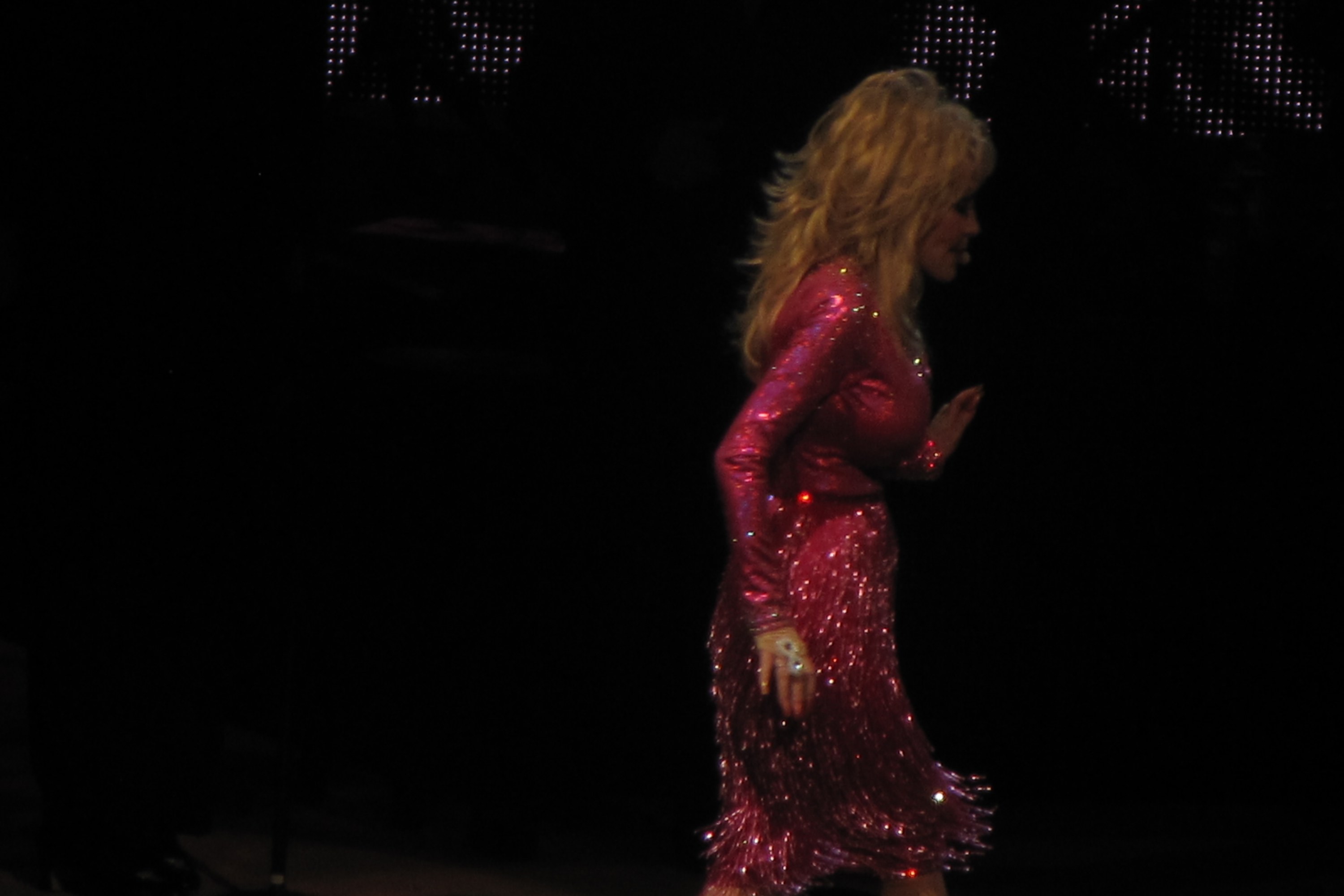
By 2016 she had refined it to nine words — "There ain't much real about me but my heart" — and was estimating her own wig collection at 365, one for every day of the year. The clothes, for the last three decades, were made by Steve Summers, whom she met when he was a Dollywood performer, put through the Fashion Institute of Technology at her own expense, and installed in 2006 as creative director of her company. He and his team built her something in the region of three hundred outfits a year, every one custom, down to the shoes.
The joke she repeated for half a century — that it costs a lot of money to look this cheap — was never self-deprecation. It was an invoice.
A one-room cabin, and a doctor paid in cornmeal
She was born on 19 January 1946 in a one-room cabin in Sevier County, in the Tennessee Smokies, the fourth of twelve children. Her father, Robert Lee Parton, worked as a sharecropper before taking on a small tobacco farm, supplementing it with construction work. Her mother was Avie Lee Caroline Owens. The missionary doctor who delivered her, Robert F. Thomas, was paid with a sack of cornmeal, because that was what the family had.
Her father could not read or write. That fact would eventually cost her a great deal of money, in the best possible way.
She was on the radio at ten, singing on Cas Walker's programme on WIVK in Knoxville and then on WBIR-TV, having been got backstage by her uncle Bill Owens. She stood on the stage of the Grand Ole Opry at thirteen. That same year, 1959, Goldband Records released her first single, "Puppy Love", recorded in Lake Charles, Louisiana, after a thirty-hour bus journey with her grandmother. She remembered the bus better than the record: "It was a combination of diesel fuel, Naugahyde, and people who were going places."
She graduated from Sevier County High School in 1964 and left for Nashville the following day. On that first day in the city she met a young man outside the Wishy Washy Laundromat. Carl Dean owned an asphalt-paving business, had no interest whatsoever in show business, and — as she told it — "looked at my face (a rare thing for me)." They married in Ringgold, Georgia, on 30 May 1966, and stayed married for fifty-nine years. He gave perhaps a handful of interviews in all that time.
The song that was a resignation letter
She joined The Porter Wagoner Show in 1967 and stayed seven years, becoming a national figure as one half of a duo in which she was, structurally, the junior partner. In 1969, on Wagoner's tour bus with no paper to hand, she wrote "Coat of Many Colors" on the back of a dry-cleaning receipt from one of his stage costumes. It went to number four on the country chart in 1971. Wagoner had the receipt framed. It hangs in a museum at Dollywood.
By 1974 she wanted out, and could not find the words to say so. "How am I gonna make him understand how much I appreciate everything, but that I have to go?" she said later. So she wrote it down instead, and played it to him in his office.
"I Will Always Love You" is not a love song. It is a resignation letter, and the most famous one ever written. Wagoner listened to it and said it was the best thing she had ever written — then told her she could go, on condition that he produced the record. It went to number one on the country chart in June 1974. She re-recorded it for The Best Little Whorehouse in Texas in 1982 and it went to number one again, a feat almost nobody has managed with the same song.
Wagoner later sued her for around $3 million, arguing that he had made her and was owed a share of her career in perpetuity. She settled, reportedly for about a third of that, and declined to be bitter in public. "I made up my mind that if he could live with it, I could live without it," she said. They reconciled in the late 1980s. She was at his bedside when he died in 2007.
The most profitable no in music history
In 1974 Elvis Presley wanted to record "I Will Always Love You". Parton was ecstatic — she told everyone she knew. Then Colonel Tom Parker explained that Presley's people took half the publishing on anything he recorded, and that this was simply the rule.
She was twenty-eight years old.
“He said, ‘Well, it’s just a rule.’ So I said, ‘Well, it’s not my rule.’”
On refusing Colonel Tom Parker, recalled in 2020
"I cried all night long," she said, "'cause I was so disappointed." But she did not move, and her reasoning was not sentimental. "These are my songs," she said years later. "They're like my children. And I expect them to support me when I'm old."
In 1992 Whitney Houston recorded it for The Bodyguard. It spent fourteen consecutive weeks at number one on the Billboard Hot 100, was certified diamond, and became the best-selling single ever released by a female solo artist. Parton, as sole writer and publisher, was paid on every copy.
She spent some of it on an office complex in a predominantly Black neighbourhood of Nashville. "This is the house that Whitney built," she said. "I'm going to be down here with her people, who are my people as well."
She held on to nearly everything she ever wrote. By the end she said the catalogue ran past three thousand songs — there is no independent tally, and there never was — and Forbes valued it at around $120 million. That single refusal in 1974 is the reason she died a woman who owned her own work, in an industry that has taken it from almost everybody else.
Jolene, and the acrylic nails on the record
"Jolene" was cut at RCA Studio B in Nashville in May 1973 and released the following January. It went to number one on the country chart and, two years later, to number seven in Britain. It has since been recorded by the White Stripes, by her goddaughter Miley Cyrus, and in 2024 by Beyoncé.
Its origins are unglamorous and very funny. The name came from an eight-year-old girl in an autograph queue. The plot came from a bank teller with red hair who paid a great deal of attention to Carl Dean, who in turn developed an unusual enthusiasm for going to the bank. "Hell, you're spending a lot of time at the bank," Parton told him. "I don't believe we've got that kind of money." Her own verdict: "It's really an innocent song all around, but sounds like a dreadful one."
Seven years later she wrote another standard on a film set, drumming her acrylic fingernails while waiting between takes on 9 to 5. The nails are credited as an instrument on the finished record. The song went to number one on the pop, country and adult contemporary charts, was nominated for an Academy Award and won two Grammys. The film — her screen debut, opposite Jane Fonda and Lily Tomlin — took more than $103 million.
The Best Little Whorehouse in Texas followed in 1982, and Steel Magnolias in 1989. "Islands in the Stream", written by the Bee Gees and sung with Kenny Rogers, topped three charts in 1983. In 1987 she made Trio with Linda Ronstadt and Emmylou Harris, which won a Grammy and remains the finest record any of the three ever made with anyone else.
THE RECORD
Seven decades on the country chart
COUNTRY HITS
113
The most by any woman in the history of the US country chart.
NUMBER ONES
25
Also a record for a female artist, spanning 35 years.
STUDIO ALBUMS
66
More than any other female country singer.
DECADES
7
Consecutive decades with a top-20 country hit, from the 1960s on.
She won ten competitive Grammy Awards from more than fifty nominations, plus a lifetime achievement award in 2011. She entered the Country Music Hall of Fame in 1999 and the Rock and Roll Hall of Fame in 2022.
Source: Guinness World Records; the Recording Academy.
Pigeon Forge
In May 1986 she put her name and her money into a struggling theme park in Pigeon Forge, in the county she was born in, and called it Dollywood. It draws close to three million visitors a season, employs around four thousand people, and is the largest employer in its community. Forbes put her personal fortune at $450 million last year — other estimates run considerably higher — and attributed the bulk of it not to the songs but to the park.
That is the part of the story people find surprising. It should not be. She went home and built an industry there.
The books, and everything else she paid for
She started the Imagination Library in 1995 and the first books went out to Sevier County children the following year. The scheme posts one free book a month to any registered child, from birth until they start school, regardless of what their parents earn. She ran it for thirty years.
She did it for her father, who could not read or write.
“Daddy couldn’t read and write, and it was kind of crippling to him.”
Dolly Parton, NPR, 2018
Not long before he died, she said, he told her he was prouder of the Imagination Library than of anything else she had ever done.
THE BOOKS
304m
Books posted free to children since 1996 — 304,539,509 of them by the end of last year. One goes into the post every 0.78 seconds.
EVERY MONTH
3.4m
Books mailed, through more than 2,800 local partners.
COUNTRIES
5
The US, Canada, the UK, Australia and the Republic of Ireland.
TO IRELAND, 2025
78,185
Books posted to Irish children last year alone.
HER TARGET
1 billion
“I’m a big dreamer, you know?”
Source: Dolly Parton’s Imagination Library 2025 Year in Review; the Dollywood Foundation.
The Imagination Library is the famous one, and it is not the half of it. She set up the Dollywood Foundation in 1988, before the books, to attack the school dropout rate in the county she came from. The Buddy Program, launched in 1990, paired every seventh and eighth grader with a partner and paid each of them $500 out of her own pocket if they graduated. By the Foundation’s own account the dropout rate for participating classes fell from 35 per cent to six.
From 2000 she funded five $15,000 scholarships a year for Sevier County school-leavers, and kept doing it.
THE GIVING
Some of what she wrote cheques for
2007 · SEVIERVILLE
$1m
Raised for the hospital birthing unit, now the Dolly Parton Center for Women’s Services.
2016 · WILDFIRES
$12m+
My People Fund. Roughly 900 families got $1,000 a month for six months, the last payment raised to $5,000.
2017 & 2022 · VANDERBILT
$2m
Two separate gifts: paediatric cancer, then paediatric infectious disease.
2020 · COVID-19
$1m
To Vanderbilt University Medical Center, weeks into the pandemic.
2021 · TENNESSEE FLOODS
$700k
Raised with her Smoky Mountain businesses for Humphreys County.
2024 · HURRICANE HELENE
$2m
$1m of her own and $1m from her East Tennessee companies.
2022 · FROM BEZOS
$100m
Handed to her with no strings to give away as she chose. She never published where it went.
SINCE 2022 · STAFF
Free
Full tuition, fees and books for every Dollywood employee from their first day, seasonal staff included.
No audited total of her lifetime giving has ever been published, and we are not going to invent one. These are the sums that can be sourced.
Sources: the Dollywood Foundation; Vanderbilt University Medical Center; Business Wire; contemporaneous reporting.
The Covid donation is the one most often garbled, so it is worth stating precisely. In April 2020, weeks into the pandemic, she gave $1 million to Vanderbilt University Medical Center. She did not fund the Moderna vaccine. What her money paid for, in the words of Vanderbilt’s Dr Mark Denison, was the test “that we used to first show that the Moderna vaccine was giving people a good immune response that might protect them.” The fund is acknowledged in the footnotes of the paper in the New England Journal of Medicine. Asked about it on television, she did not make a speech: “We can’t save the world, but we can save the world we’re living in.”
Then there is the $100 million. In November 2022 Jeff Bezos handed her the Courage and Civility Award, which comes with that sum and no conditions. Her first reaction, on camera, was “Did you say a hundred million?!” She never published an account of where it went, and no recipient has been publicly identified. It is entirely characteristic: she talked constantly about giving and almost never about amounts.
“I never know what I’m going to do or why I’m gonna do it. I just see a need, and if I can fill it, then I will.”
Dolly Parton on her giving, 2022
She was given the Carnegie Medal of Philanthropy in 2022, and the National Education Association’s Friend of Education award the same year. On the subject of being praised for any of it she was characteristically unbothered: “I don’t do it for attention. But look! I’m getting a lot of attention by doing it.”
The Imagination Library operates in five countries. Ireland is one of them.
Tallaght, Cork, and a pub in Ventry
The Republic of Ireland became the fifth country in the Imagination Library on 14 February 2019, launched at the county library in Tallaght and run here by the Childhood Development Initiative. Cork followed in November 2020, reaching around three thousand children across Knocknaheeny, Hollyhill, Gurranabraher, Churchfield, Mahon and Carrigtwohill, and two direct provision centres. An Post carried the books free for the first year. By the time Cork launched, the Tallaght programme had enrolled nearly five thousand children and posted out some 87,000 books.
By March 2022 more than 200,000 books had gone to Irish pre-schoolers; in Cork alone, over 66,000 to 2,888 children. There is one last detail, and it is almost too neat. The final book an Irish child receives, on their fifth birthday, as they leave the scheme — is The Selfish Giant, by Oscar Wilde.
She sent a message to the Cork launch. She was seventy-four, it was the middle of a pandemic, and she had no particular reason to say anything at all.
“Cork, and all of Ireland, has a special place in my heart. It feels like home to me and hopefully one day, sooner than later, I will be coming home again!”
Message to the Cork launch of the Imagination Library, November 2020
There is a temptation, on a day like this, for an Irish publication to claim her. It should be resisted, and she would have been the first to say so. When she traced her mother's people, the Owens, for television, the line ran back to Wales, not to Ireland. Her connection here was never genealogical.
It was musical, and she understood it better than most people who write about it. The ballad tradition she was raised inside — "Barbara Allen", "Pretty Polly", "The Cuckoo" — came down the Wilderness Road into Appalachia with emigrants from Ulster, the Scottish lowlands and the north of England, and survived there in versions that had died out at home. When Cecil Sharp went collecting in the southern Appalachians between 1916 and 1918, he found more than two hundred Old World ballads still being sung in the mountains.
Parton wrote the foreword to Wayfaring Strangers, the standard popular account of exactly that migration. "This music is close to my heart," she wrote, "and part of my DNA."
She put it more plainly on The Late Late Show in December 2020: "I think it is why the Irish have always loved me and I have always loved them. We speak the same language." And then, unprompted, the part that explains the whole relationship: "They appreciate and know what it is like to live hard and to be brought up poor, and I think that they know when I am singing it, I mean it."
She had been here before, quietly. Around 1990, on holiday on the Dingle Peninsula, she walked into Páidí Ó Sé's pub in Ventry, was recognised, and was talked into singing. "Well, hello," she told the room, "and welcome to Ireland. My name is Dolly and I'm on vacation. I was not going to sing tonight." Then she sang "Coat of Many Colors" — a song about a poor mother sewing a coat out of rags for a child who gets laughed at for wearing it — in a pub in west Kerry, to people who did not need it explained.
She played here more often than most people remember — fourteen shows on this island between 2002 and 2014, six of them in Belfast, three in Dublin, two at Live at the Marquee in Cork, and one in a hurling ground in Kilkenny.
ON THIS ISLAND
Fourteen nights, 2002 to 2014
2002
Waterfront Hall, Belfast, and the Point Theatre, Dublin — her first shows here, on the Halos & Horns tour. The Belfast set closed with “Coat of Many Colors”, “Jolene”, “9 to 5”, “I Will Always Love You” and “Stairway to Heaven”.
2007
Two nights at the Odyssey in Belfast, one at the Point.
2008
Live at the Marquee in Cork on 21 June, Nowlan Park in Kilkenny the following night, then two more in Belfast.
2011
The O2 in Dublin and the Odyssey in Belfast, on the Better Day tour.
2014
Belfast, Dublin and a second night at the Marquee in Cork — the last time she performed in Ireland.
The Point is now the 3Arena; the Odyssey is now the SSE Arena.
Dates compiled from setlist archives and contemporaneous reporting.
The Cork night in 2008 has become the one people tell stories about. It rained, as it does, and the roof over the stage leaked. She opened with “Two Doors Down”, stepped carefully around a puddle that had formed on the boards, looked at it, and told the audience: “Hell, I always wanted to die on stage in front of a crowd.”
The things she turned down
She was offered the Presidential Medal of Freedom three times and accepted it none of them — twice under Donald Trump, once under Joe Biden. The first refusals were practical: Carl was ill, and then there was Covid. The last was not. "I just don't want even the appearance of being partisan in any way," she said.
In March 2022, nominated for the Rock and Roll Hall of Fame, she withdrew. "I don't feel that I have earned that right," she wrote, adding that she did not want to split the vote. The Hall declined to remove her, on the reasonable grounds that rock and roll has always been part country. In April she gave in — "I'll accept gracefully" — and in November she was inducted by Pink, performing "Jolene" with a stage full of people who had spent their careers covering her.
Then, being who she was, she went away and made a rock album to justify it. Rockstar came out in 2023: thirty tracks, McCartney, Starr, Stevie Nicks, Rob Halford. At seventy-seven it gave her the highest-charting solo studio album of her life.
In her own words
She was, among other things, one of the great one-line writers of the American century — a woman who could disarm an interviewer, make a point about class and end the conversation in a single sentence, and who did it for sixty years without ever appearing to try.
IN HER OWN WORDS
Sixty years of getting the last word
“I would never stoop so low as to be fashionable. That’s the easiest thing in the world to do.”
To Barbara Walters, 1977
“The way I look was really a country girl’s idea of what glamour was. I patterned my look after the town tramp.”
Rolling Stone, 2003
“I look so totally artificial, but I’ve always been the simplest person in the world.”
Rolling Stone, 2003
“There ain’t much real about me but my heart.”
2016
“These are my songs. They’re like my children. And I expect them to support me when I’m old.”
On refusing to sell her publishing
“He said, ‘Well, it’s just a rule.’ So I said, ‘Well, it’s not my rule.’”
On Colonel Tom Parker and Elvis, recalled 2020
“If you can read, it gives you wings to fly.”
NPR, 2018
“The only thing I ever saw growing up was poor people. But in my books, I would read about kings and queens.”
On why she started the Imagination Library
“We can’t save the world, but we can save the world we’re living in.”
On her Covid-19 donation, 2020
“He knows every hair in my wig.”
On Carl Dean, 2014
“I’m a rock star now! This is a very special night for me.”
Rock and Roll Hall of Fame induction, 2022
“I just don’t want even the appearance of being partisan in any way.”
Declining the Presidential Medal of Freedom, 2023
One line everyone will quote today — that it costs a lot of money to look this cheap — has no traceable first outing. She said it, in one form or another, for fifty years.
The last two years
Carl Dean died on 3 March 2025, aged 82, after fifty-nine years of marriage. "Words can't do justice to the love we shared for over 60 years," she said. Four days later she released a song for him, "If You Hadn't Been There". She had lost a brother, David, the previous November, and would lose another, Coy "Denver" Parton, five weeks ago.
Her own health went after that, and she was straightforward about it in the way she was straightforward about everything. She postponed her Las Vegas residency in September 2025 and cancelled it outright last May, after a kidney stone and an infection. "I can't be dizzy carrying around banjos, guitars, and such on 5-inch heels," she said. In November she accepted an honorary Oscar — the Jean Hersholt Humanitarian Award — by video rather than in person, and used the speech to talk about her mother and father: "the more you give, the more blessings come your way."
On 14 August she pulled out of opening a new rollercoaster at Dollywood on her doctor's advice, appeared by video wearing a pair of fairy wings, and said he had clipped them. Three days ago she gave an interview about her health in which she said she had been ignoring her own symptoms while she nursed Carl.
“Even though I’m still healin’, I’m still workin’.”
Her last published interview, three days before her death
She was still working. DOLLY: A True Original Musical, with a book she co-wrote and a score she wrote alone, is scheduled to begin previews at the St James Theatre on Broadway on 7 December. Opening night is set for 19 January 2027 — her eighty-first birthday.
What they said about her
The tributes started within minutes and had not stopped by the time this was published. What is striking about them, read together, is how few are about her singing.
The Country Music Hall of Fame, of which she had been a member since 1999, got closest to it in two sentences: “Dolly Parton’s legacy is not celebrity, but humanity. She was a champion of equality and literacy.” The Grand Ole Opry, where she first stood on a stage at thirteen, said her mark “will be deeply felt for generations to come.”
Miley Cyrus, her goddaughter, was brief. “I can’t believe we just lost the purest soul,” she wrote, in a message reported by ITV News. “Rest in Glory, Dolly. My heart aches.”
Reba McEntire posted a long, plain message that read like a letter. “Well, I just got the news that my buddy Dolly passed onto the higher and greater side,” it began, and ended: “There will never ever be another you… I will always love you, Reba.”
Kacey Musgraves managed a handful of lines, one of which has been repeated everywhere since.
“The world feels a lot less sparkly all of a sudden.”
Kacey Musgraves
Blake Shelton, who worked alongside her on The Voice, wrote the longest and the warmest of them: “I want everyone to know that she was the EXACT person that you think she is. It was like being with the funnest, most loving, most caring and closest member of your family. Truly a loss for the entire world.”
That observation — that she turned out to be exactly who she appeared to be — recurs in almost every tribute posted today. Seth MacFarlane, who directed her once, put it almost identically: “It was a joy to discover that she really was exactly the person we all hoped she was.”
Sarah Trahern, chief executive of the Country Music Association, remembered the professional rather than the icon: “She was always the most professional in every setting, often walking off the bus in heels and hair and makeup ready to go, before expected and before the cast and crew.” And then: “Along with the music, our biggest loss today is her work as a philanthropist and the genuine difference she has made in people’s lives throughout the world.”
Julia Roberts, who made Steel Magnolias with her in 1989, said in a statement: “Dolly was a magical and joyous human. I hold knowing her as a treasure in my life. The sun has dimmed today.” Sally Field, from the same film: “There will never be another. I adored her with all my heart and will always cherish our time together.” Lily Tomlin, her 9 to 5 co-star, posted a black-and-white photograph of the two of them and three words: “No words…”
Jack White, whose band took “Jolene” to a new audience, wrote two: “Instant Sainthood.” Carole King: “My heart is breaking. In addition to her musical talents, she was an exemplary human being.” Dionne Warwick: “I will certainly miss her laughter, jokes and her being. Rest well and in total peace my friend.” Steve Martin, banjo player, needed two words: “Crushing loss.”
Kelly Osbourne wrote the clearest account of what she meant to women: “Thank you for paving the way. Not only for women in music, but for women everywhere to be unapologetically themselves. You showed us that we could be ambitious and kind, strong and soft, fearless and authentic.”
Sarah Jessica Parker had never met her, and said so: “I don’t think any of us had to know her to love her.”
Politically she remained what she had always been, which is to say claimed by everyone. Bill Clinton said she “told the stories of everyday Americans with honesty, humility, and heart,” and “never forgot where she came from.” Bernie Sanders called her “a lifelong philanthropist and advocate for literacy, education, LGBTQ+ rights.” Marsha Blackburn, Tennessee’s Republican senator, said her life was “forever woven into Tennessee’s music, culture, and history.” Zohran Mamdani, the mayor of New York, called her “an irreplaceable champion of the working class.” The President called her loss “a true loss for millions of people” and ordered flags lowered nationwide for a week; Tennessee’s governor Bill Lee lowered them statewide for “Tennessee’s favorite daughter.”
Jeff Bezos, who four years ago handed her $100 million to give away: “Dolly spent her whole life showing us what it means to lead with love.” And J.K. Rowling, on the thing she was proudest of: “Dolly Parton’s Imagination Library was the best contribution to child literacy ever made by a celebrity.”
And here
Irish reaction came more slowly, because the news broke here at seven in the evening. The first substantial tribute came from Mary Lou McDonald, the Sinn Féin leader, and it went where most of them went — past the music, to the books.
“Her legacy also reaches far beyond music. Through her incredible charitable work, particularly the Imagination Library, she helped give millions of children the gift of reading.”
Mary Lou McDonald
“I’ve been a big fan of Dolly and her music for as long as I can remember,” she wrote. “She was a remarkable songwriter, a trailblazer for women and someone whose warmth and humour connected with people everywhere… There really was nobody quite like Dolly.”
Fr Brian D’Arcy, who met her several times over the years, told RTÉ that she had mesmerised him, and that “no matter what happened, she always left us happy.” The Tyrone country singer Cliona Hagan paid tribute on the Nine O’Clock News.
Nothing yet, at the time of writing, from the Taoiseach or the President.
What she actually did
The most quoted thing about Dolly Parton is that everybody liked her, which is true and is the least interesting thing about her. Plenty of people are liked. Almost none of them convert it into ownership.
She took a look that invited people to dismiss her and used the cover it gave her to keep her copyrights, build a park, fund a research laboratory, decline three presidents, and post free books to a child in Knocknaheeny every month for five years. She was laughed at for the wigs by people who never noticed she owned the building.
The family statement asks that people mark her death by giving to the Imagination Library rather than sending flowers. That is the correct instruction and it is worth following. The books are still going out this month — 3.4 million of them, to five countries, one of which is this one.
Sourcing note. Her death was announced on 25 August 2026 by her nephew and longtime head of security, Bryan Seaver, on her social media accounts; outlets differ on which platform carried it first, so we have not specified one. The family statement, including the "rhinestone life" wording and the request for donations to the Imagination Library in lieu of flowers, is reproduced identically by The Music Universe, BroadwayWorld and Clash, none of which attributes it to a named individual. No cause of death has been given and we have not speculated on one. Her death is reported by CNN, NBC News, Variety and The Hollywood Reporter, among others, and by RTÉ. Biographical detail is drawn from the Country Music Hall of Fame, her own official site and her 1994 memoir Dolly: My Life and Other Unfinished Business. The Barbara Walters exchange dates from 1977; the "town tramp" and "totally artificial" quotations from Rolling Stone (2003); "there ain't much real about me but my heart" and the wig count from a 2016 interview. The line about it costing a lot of money to look this cheap has no traceable first use — she said it, repeatedly, for fifty years. Chart and record figures are from Guinness World Records and the Recording Academy; we give ten competitive Grammys plus a 2011 lifetime achievement award, which is where the commonly printed figure of eleven comes from. The Elvis account and the "not my rule" exchange are from dated interviews she gave in 2006, 2020 and 2021; the Whitney Houston chart figures are from Billboard. Wealth and catalogue valuations are Forbes estimates, not audited accounts, and other published estimates are higher. Imagination Library figures are from the programme's own reporting; the Irish launch details and her Cork message are from the Irish Examiner, November 2020. The announcement video was posted to her own verified TikTok and Instagram accounts, captioned “A message from the family of Dolly Parton”; Bryan Seaver’s remarks are quoted from that video and from wire reports of it, and we have embedded the official post rather than reproducing it. Tributes are quoted from the individuals’ own posts or from statements given to named outlets, all published on 25 August 2026. Miley Cyrus’s words are as reported by ITV News and other outlets; we could not locate the original post and have attributed it accordingly. Kacey Musgraves’s message is rendered differently by different outlets and we have quoted only the sentence on which all agree. Irish reaction is from RTÉ and from Mary Lou McDonald’s own account. Irish Imagination Library figures are from RTÉ and Cork City Council. where outlets differed on wording or platform we have used the version carried by two or more independent sources, and we have omitted quotations we could not render exactly. Philanthropy figures come from the Dollywood Foundation’s own published history, its IRS filings, Vanderbilt University Medical Center, Business Wire and contemporaneous reporting; the Imagination Library totals are from its 2025 Year in Review, including the figure of 78,185 books posted to Irish children last year. The Buddy Program dropout figures are the Foundation’s own. No audited total of her lifetime giving exists and we have not assembled one. The Bezos award was made in November 2022; no account of its distribution has been published and no recipient has been identified. Irish concert dates are compiled from setlist archives, which are user-contributed, together with contemporaneous reporting; the Cork show of 21 June 2008 and her remark about the puddle are as reported by the Irish Examiner. The Appalachian ballad history follows standard scholarship, including Cecil Sharp's 1916–18 collecting trips; her foreword to Wayfaring Strangers was published in 2014. Her Late Late Show remarks were broadcast in December 2020. We have not claimed Irish ancestry for her: her maternal line has been traced to Wales, and the connection she described was musical. Photographs are used under Creative Commons licences, by Leeann Cafferata (CC BY 2.0), Mel Melcon of the Los Angeles Times (CC BY 4.0) and Kristopher Harris (CC BY 2.0). We have not reproduced any photographs from her own social media accounts, which are copyrighted.
You Might Also Like
The latest from The Moiré Edit.